
Booklet · Information Systems & Digital Transformation
Adapting offerings and content with marketing prompt templates
This booklet brings together six marketing prompt templates for generative artificial intelligence assistants. It covers offer messages, the content plan, public competitor information, the product sheet, the satisfaction survey and translation. Several instructions restrict the assistant to the information provided or publicly available. The booklet is an extract from the library of prompt templates by function.
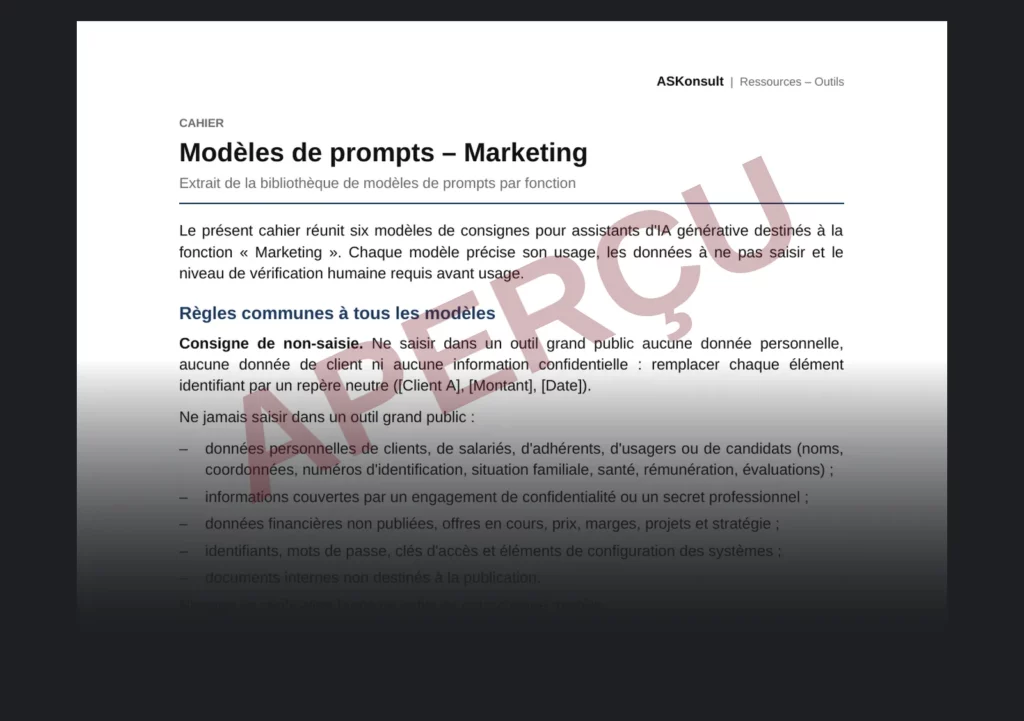
What the booklet of marketing prompt templates contains
- The common rules: no-entry instruction, neutral placeholders such as [Client A] or [Amount], and three levels of human verification.
- “Turning an offer into messages”: three formats, with no invented figure, client, testimonial or guarantee.
- “Preparing a content plan”: title, objective, format and channel of each piece of content, with no publication date.
- “Analysing public competitor information” according to defined criteria, with a clear distinction between observed facts and inferences.
- “Writing a product sheet” solely from the information provided: use, features, conditions, items not included.
- Finally, “Preparing a satisfaction questionnaire” with no identifying question, then “Adapting a text to another language”.
When to use the booklet
The booklet is used when a team presents an offer, organises an editorial calendar or compares public offerings. It is also used to describe a product, design a short survey and prepare a translated version. Moreover, the proposed survey excludes any question that could identify the respondent. It is aimed in particular at marketing managers and communication officers.
Instructions for use
First, the selected template is copied into the AI assistant. Next, each item in square brackets, such as [audience], [sector] or [criteria], receives anonymised or public information. Then length and format are adapted to the target channel. Finally, the indicated verification level applies. Thus, the competitor analysis and the translation require checking; the offer messages and the product sheet, validation.
Expected outcome
The marketing prompt templates thus deliver drafts: adapted messages, content plan, comparison table, sheet or questionnaire. The competitor analysis also flags missing information. Any external distribution, however, requires the planned verification.
Key facts
| Format | PDF, 2 pages; Word |
|---|---|
| Languages | French |
| Version | October 2026 |
| Departments | Information Systems & Digital Transformation |
| Prerequisites | Access to a generative AI assistant; anonymised information |
| Audience | Marketing managers, communication officers |
Limitations
The templates produce drafts; they do not dispense with the human verification indicated for each. Moreover, the no-entry instruction excludes client data and current offers from consumer tools. Posts specific to social media are covered in a separate booklet. References to legal texts must be checked against the wording in force on the date of use.
Further reading: Information Systems & Digital Transformation; Law No. 09-08 on the protection of individuals with regard to the processing of personal data.
- Prepared by ASKonsult
- Version: octobre 2026
In the same field
Booklet · Information Systems & Digital Transformation
Preparing posts and replies with social media prompts
This booklet brings together six templates of social media prompts, intended for generative artificial intelligence assistants.
Booklet · Information Systems & Digital Transformation
Preparing decisions and committees with management prompt templates
This booklet brings together six management prompt templates for generative artificial intelligence assistants. Each template specifies its use, the data not to be entered and the level of human verification required.
Guide · Information Systems & Digital Transformation
Good and bad practices for generative AI at work
Good practices for generative AI at work come down to a few rules applicable to any tool. They thus precede the adoption of a use charter specific to the organisation.
Going further Equipping each department with a prompt library by function
General information document; it constitutes neither legal advice nor an opinion on a particular situation. References to legal texts should be checked against the version in force on the date of use.
Licence of use: internal use by the purchaser, non-exclusive and non-transferable; resale, distribution and making available to third parties excluded (Law No. 2-00).
Consulting firm not registered with the Bar; no representation before the courts and no act reserved to the regulated legal professions.