
Template · International Trade & Export
Drawing up a supplier’s declaration for products having preferential origin status
The supplier’s declaration certifies, for the benefit of the exporting buyer, the preferential originating status of the goods delivered. The exporter then bases the proof of origin presented on importation on this document. The template therefore reproduces the two forms provided for in Implementing Regulation (EU) 2015/2447: single and long-term. It also provides a document that can be relied upon during an origin verification.
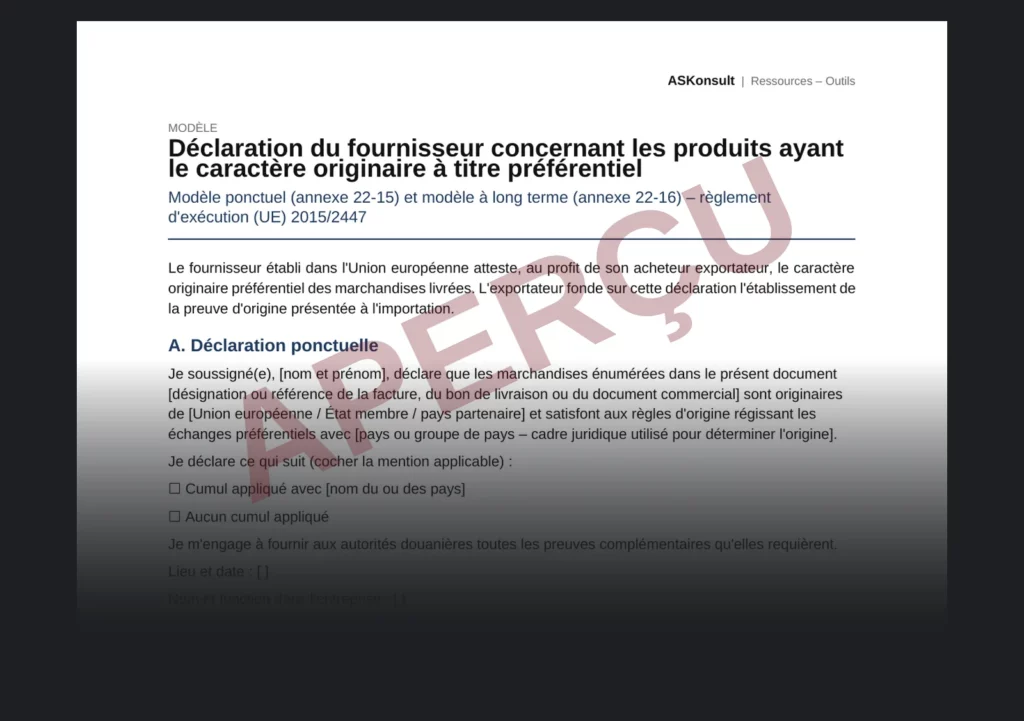
What the supplier’s declaration template contains
- A single declaration, made out on the commercial invoice, the delivery note or any other commercial document.
- A long-term declaration for regular consignments, together with an undertaking to inform the buyer if it ceases to be valid.
- The boxes to be ticked on cumulation, applied or not, with the name of the country or countries concerned.
- The undertaking to provide the customs authorities with any additional evidence they require.
- Notes for use on the period covered, the regulatory wording and the legal framework of origin.
- References to Implementing Regulation (EU) 2015/2447 and Implementing Regulation (EU) 2025/1728.
When to draw up this declaration
The supplier established in the European Union completes this declaration when its buyer exports in the context of preferential trade. The single form covers a specific delivery. By contrast, the long-term form covers products regularly supplied to the same buyer. The document concerns, in particular, tier 1 and tier 2 suppliers, industrial buyers and exporters. It also documents the originating status of inputs in the event of a verification.
Instructions for use
The supplier first chooses the single or the long-term form. It then describes the goods and, for the long-term form, the period covered. This period does not exceed twenty-four months from its start date. Next, it indicates the origin, the legal framework used and the cumulation entry. Finally, it signs and archives the declaration and plans its renewal.
Expected outcome
The supplier then has a supplier’s declaration that reproduces the wording of Annexes 22-15 and 22-16. The exporting buyer therefore bases its proof of origin on a dated, signed and archived document.
Key facts
| Format | PDF, 2 pages; Word |
|---|---|
| Languages | French |
| Version | October 2026 |
| Departments | International Trade & Export; Customs Compliance & Litigation |
| Prerequisites | Nomenclature of the products delivered and origin information on inputs |
| Audience | Tier 1 and tier 2 suppliers, industrial buyers, exporters |
Limitations
The template covers neither adaptation to the specific case, nor review, nor validation, nor follow-up, which fall within consultations and packages. It includes no representation. Moreover, products without preferential originating status fall under the templates in Annexes 22-17 and 22-18.
Further reading: International Trade & Export; Implementing Regulation (EU) 2015/2447 (EUR-Lex).
- Prepared by ASKonsult
- Version: octobre 2026
In the same field
Checklist · Customs Compliance & Litigation
Preparing for a post-clearance verification of preferential origin
A post-clearance origin verification puts at stake the preferential tariff treatment granted on importation into Morocco. Indeed, the administration may ask the exporting country to verify a proof of origin.
Questionnaire · International Trade & Export
Preparing for a supplier due diligence audit
The supplier due diligence audit is prepared before the European buyer makes its request. Large European companies indeed have to address adverse impacts on human rights and the environment among their partners.
Checklist · International Trade & Export
Measuring exposure to the Carbon Border Adjustment Mechanism
CBAM exposure concerns exporters of steel, aluminium, cement, fertilisers, electricity or hydrogen to the European Union. The mechanism indeed entered its definitive period on 1 January 2026.
Going further Customs rules of origin consultation: tariff classification, applicable rule and proofs
General information document; it constitutes neither legal advice nor an opinion on a particular situation. References to legal texts should be checked against the version in force on the date of use.
Licence of use: internal use by the purchaser, non-exclusive and non-transferable; resale, distribution and making available to third parties excluded (Law No. 2-00).
Consulting firm not registered with the Bar; no representation before the courts and no act reserved to the regulated legal professions.