
Grid · Institutional Advisory & Territorial Engineering
Listing the commitments and contingent liabilities of a public body
Public body contingent liabilities weigh on the finances of the body without appearing in its budget. Indeed, these are obligations that depend on a future event: a guarantee being called, a court ruling, an arbitral award. Their materialisation may thus exceed the margins of the body. The grid therefore proceeds in three stages: inventory, rating, disclosure.
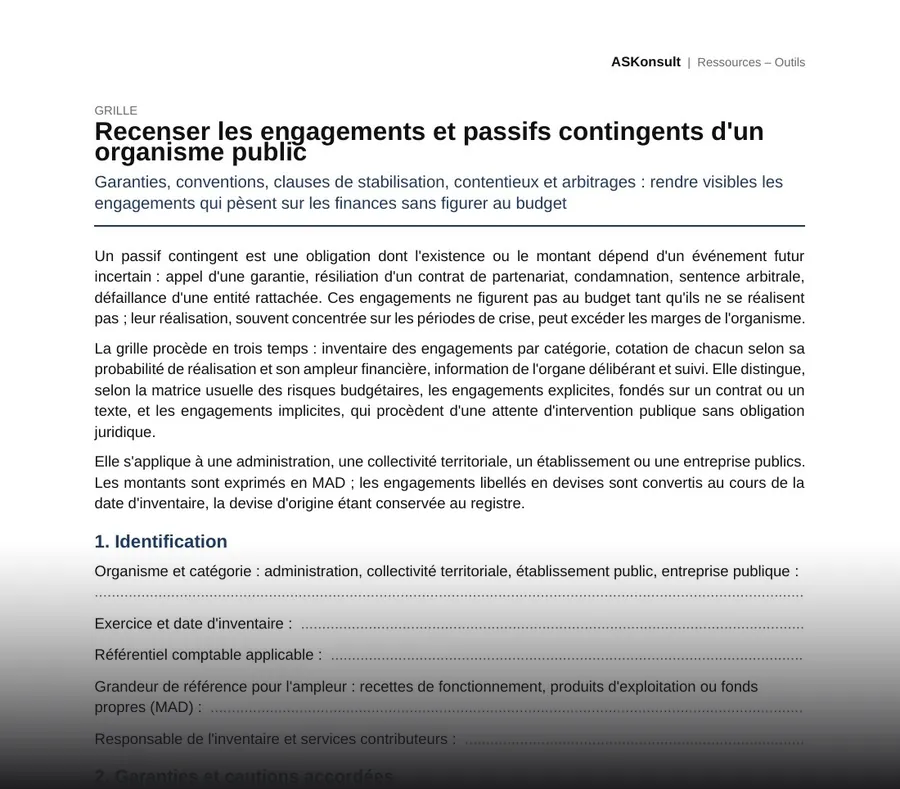
The stages of the public body contingent liabilities grid
- Identification of the body.
- Guarantees and sureties granted.
- Contractual commitments.
- Litigation and arbitration.
- Rating of probability and magnitude, then interpretation.
- Disclosure to the deliberative body and follow-up.
- Finally, a register of contingent commitments and a summary.
When to list public body contingent liabilities
The grid is used first when preparing the budget. It is also used before a new guarantee is granted. In addition, it informs the disclosure to the deliberative body.
The finance departments of local authorities and public institutions are among its main intended users. The document also concerns oversight bodies.
Instructions for use
The grid is first completed by category of commitment: guarantees, agreements, litigation. The grid then rates each commitment according to its probability and magnitude. In addition, the interpretation of the rating highlights the priority commitments. Finally, the register is updated and presented to the deliberative body.
Expected outcome
On completion of the grid, the body has a rated register of its contingent commitments. The priority commitments appear clearly. As a result, the deliberative body decides with knowledge of the risks, particularly before granting new guarantees.
Key facts
| Format | PDF, 4 pages |
|---|---|
| Languages | French, English, Spanish, Arabic |
| Version | October 2026 |
| Access | download after registration |
| Scope | local authorities, public institutions and public enterprises |
Limitations
The grid does not constitute an audit of the accounts. In addition, the rating relies on the information available at the date of the exercise. Finally, the document is to be read together with the usage notes and references it contains.
Further reading: public policy advisory; International Monetary Fund.
- Prepared by ASKonsult
- Languages: French, English, Spanish, Arabic
- Version: octobre 2026
In the same field
Grid · Institutional Advisory & Territorial Engineering
Measuring the financial and institutional capacity of a local authority
Local authority financial capacity determines whether its programmes can be delivered. Indeed, the 2015 organic laws require an assessment of projected resources and expenditure.
Grid · Tender Intelligence & Public Procurement
Deciding whether to bid for a tender
Deciding whether to bid for a tender requires assessing opportunity, capacity and risk. The grid therefore comes into play before work on a bid begins.
Going further Consultation for local authorities: capacities, prioritisation and programme monitoring
General information document; it constitutes neither legal advice nor an opinion on a particular situation. References to legal texts should be checked against the version in force on the date of use.
Consulting firm not registered with the Bar; no representation before the courts and no act reserved to the regulated legal professions.