
Register · Tender Intelligence & Public Procurement
Tracking public procurement bonds and their release
The workbook for tracking public procurement bonds records the bonds and guarantees issued in connection with contracts. Indeed, a bond that has not been returned continues to tie up a bank facility and to generate fees. The workbook therefore calculates the date on which release becomes due. It also flags releases not yet requested. A PDF presentation accompanies the workbook.
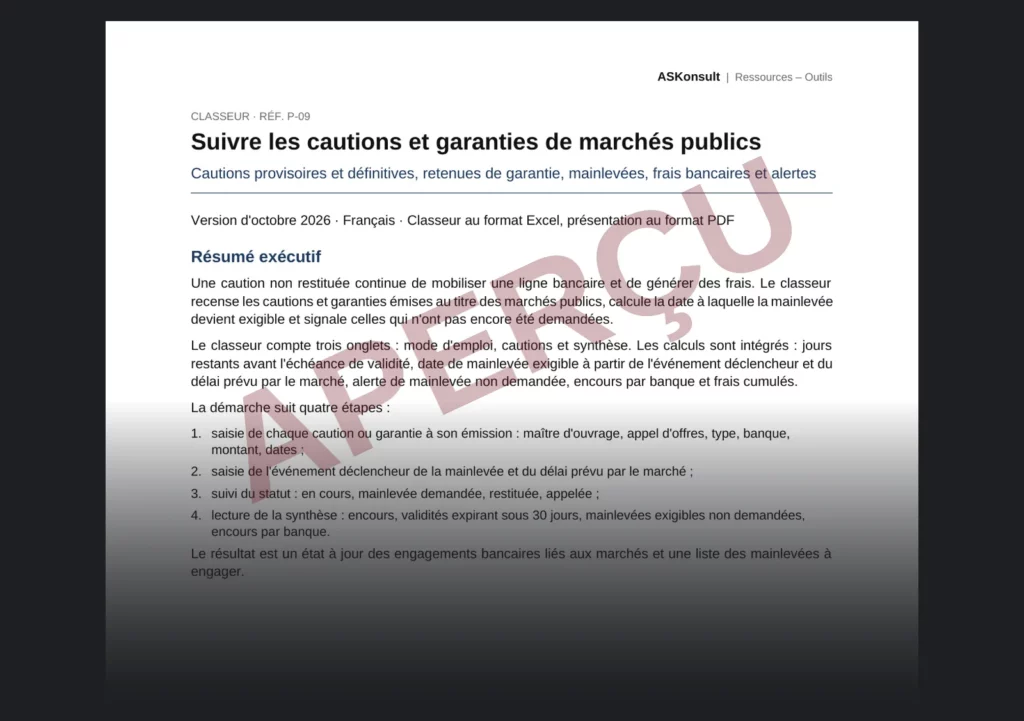
What the public procurement bonds workbook contains
- A three-tab Excel workbook: instructions, bonds and summary; greyed-out cells are calculated automatically.
- Bonds tab: two hundred lines, one per bond or guarantee, with contracting authority, call for tenders, type, bank, amount and dates.
- Built-in calculations: days remaining before the validity expiry date, date on which release is due and an alert for releases not requested.
- Summary tab: total outstanding, validities expiring within 30 days, releases requested but not returned, cumulative fees, outstanding by bank.
- Finally, a three-page PDF presentation, with the executive summary, a description of the tabs and the rules on return.
When to keep the workbook up to date
Tracking of public procurement bonds begins as soon as each provisional or final bond is issued. The workbook is then updated at each triggering event: selection of the successful bidder, provision of the final bond, final acceptance. In addition, the summary gives the outstanding amount and the number of bonds per bank. It also identifies validities expiring within 30 days. The workbook is intended, in particular, for bidding companies and holders of public contracts.
Instructions for use
First, each bond or guarantee is entered upon issue: contracting authority, call for tenders, type, bank, amount and dates. The user then enters the event triggering the release and the period provided for in the contract. Next, the status is updated: active, release requested, returned or called. Finally, reading the summary shows the outstanding amounts, upcoming deadlines and releases to be initiated.
Expected outcome
The workbook produces an up-to-date statement of the bank commitments linked to contracts. It also provides the list of releases to be initiated and the cumulative bank fees. The outstanding amount of public procurement bonds can thus be read bank by bank.
Key facts
| Format | Excel workbook; PDF presentation, 3 pages |
|---|---|
| Languages | French |
| Version | October 2026 |
| Departments | Tender Intelligence & Public Procurement |
| Prerequisites | List of ongoing contracts and bonds |
| Audience | Bidding companies and holders of public contracts |
Limitations
The workbook covers neither adaptation to the specific case, nor review, nor validation, nor follow-up; these services fall within consultations and packages. It includes no representation. Moreover, the time limits and conditions for return depend on the applicable regulations and the specifications. They are therefore to be checked for each contract; the reference text is Decree No. 2-22-431 of 8 March 2023 on public procurement. A management support tool, to be adapted to the organisation and to the applicable regulations.
Further reading: Tender Intelligence & Public Procurement; Decree No. 2-22-431 of 8 March 2023 on public procurement.
- Prepared by ASKonsult
- Version: octobre 2026
In the same field
Grid · Tender Intelligence & Public Procurement
Deciding whether to bid for a tender
Deciding whether to bid for a tender requires assessing opportunity, capacity and risk. The grid therefore comes into play before work on a bid begins.
Going further Public procurement consultation: deciding whether to bid for a tender
General information document; it constitutes neither legal advice nor an opinion on a particular situation. References to legal texts should be checked against the version in force on the date of use.
Licence of use: internal use by the purchaser, non-exclusive and non-transferable; resale, distribution and making available to third parties excluded (Law No. 2-00).
Consulting firm not registered with the Bar; no representation before the courts and no act reserved to the regulated legal professions.