
Kit · Governance & Dispute Resolution
Activating and running a crisis unit
The kit brings together the documents needed to activate a crisis unit without delay, then to run it through to closure. The first hours are indeed often lost on questions that should have been settled in calm conditions: who decides, within what limits, who keeps the written records. The documents are therefore completed during normal operations. They are then re-examined after each exercise or event.
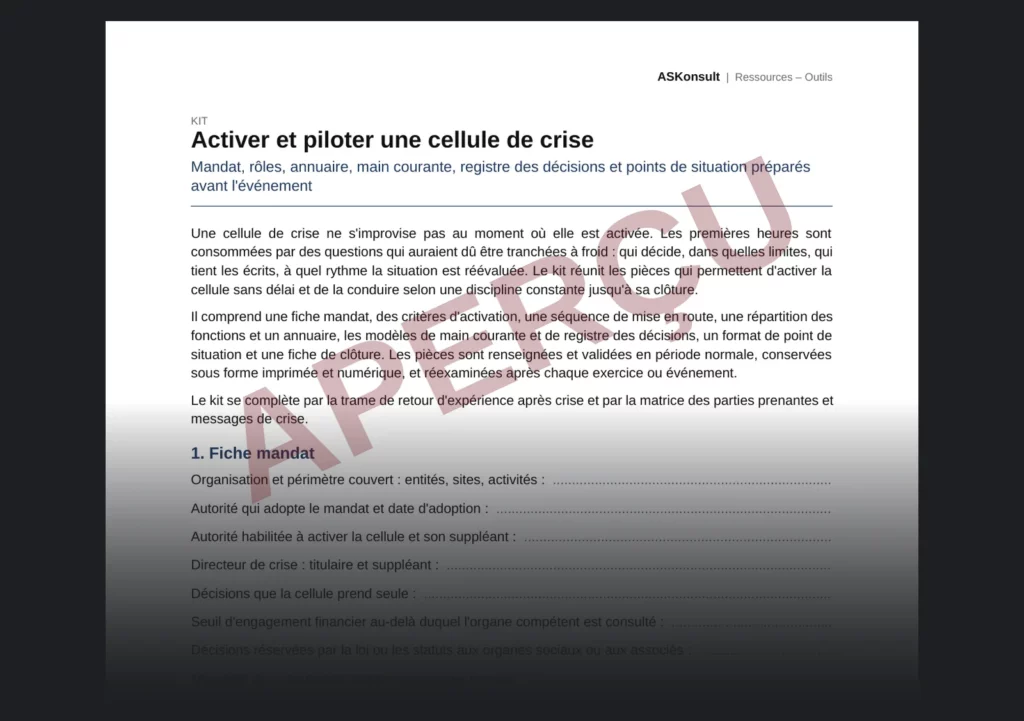
Contents of the kit
- Mandate sheet: scope, activating authority, crisis director and deputy, decisions within its own remit and reserved decisions, duration, closure conditions.
- Activation criteria, three mobilisation levels (watch, alert, activation) and a nine-point start-up sequence.
- Composition and roles, directory with primary members and deputies, crisis room and backup means of communication.
- Templates for the incident log and the decision register, with their columns and record-keeping rules.
- Situation briefing with a standing agenda, standard minutes, organisation of shift handovers and coordination with governance and third parties.
- Finally, a closure sheet, rules for maintaining readiness and ISO and Moroccan references.
When to prepare the crisis unit
The kit is prepared during normal operations, before any event. It then serves during periodic exercises, then during an actual activation. The activation criteria cover in particular threats to the safety of persons and the interruption of an essential activity. They also cover an incident affecting information systems, public accusations and the sudden unavailability of the chief executive. The kit is intended for executive management, mid-sized companies and institutions.
Instructions for use
First, the competent authority adopts the mandate and appoints the crisis director and a deputy. Next, the directory is completed, with a primary member and a deputy for each function. On activation, the incident log and the decision register are opened from the very first minute. Each situation briefing then follows the same agenda. Finally, the closure decision is entered in the register and triggers the lessons-learned review.
Expected outcome
The result is a ready-to-use crisis unit whose rules exist before the event. Each decision thus leaves a time-stamped and reasoned record in the register. Furthermore, the incident log distinguishes established facts, assumptions and unknowns.
Key facts
| Format | PDF, 6 pages; Word |
|---|---|
| Languages | French |
| Version | October 2026 |
| Departments | Governance & Dispute Resolution; Audit & Interim Management |
| Prerequisites | Organisation chart and list of key functions |
| Audience | Executive management, mid-sized companies, institutions |
Limitations
The kit is an organisational aid; its adaptation to the specific case, its review and its validation fall within a consultation. The legal characterisation of the facts, statements binding the organisation and any representation are a matter for an authorised professional. In addition, the directory and the incident log contain personal data, subject to Law No. 09-08.
Further reading: Governance & Dispute Resolution; Law No. 05-20 on cybersecurity.
- Prepared by ASKonsult
- Version: octobre 2026
In the same field
Template · Governance & Dispute Resolution
Conducting and documenting a lessons-learned review after a crisis
This template organises a lessons-learned review after a crisis or after a significant incident. It draws on the incident log, the decision register and the minutes of the situation briefings.
Questionnaire · International Trade & Export
Preparing for a supplier due diligence audit
The supplier due diligence audit is prepared before the European buyer makes its request. Large European companies indeed have to address adverse impacts on human rights and the environment among their partners.
Matrix · Governance & Dispute Resolution
Stakeholders and crisis messages
The crisis stakeholder matrix prepares crisis communication ahead of time. In a crisis, the organisation indeed lacks the time to identify whom to inform, in what order and through which channel.
Going further Crisis management consultation: assessment of the event and first decisions
General information document; it constitutes neither legal advice nor an opinion on a particular situation. References to legal texts should be checked against the version in force on the date of use.
Licence of use: internal use by the purchaser, non-exclusive and non-transferable; resale, distribution and making available to third parties excluded (Law No. 2-00).
Consulting firm not registered with the Bar; no representation before the courts and no act reserved to the regulated legal professions.