
Template · Governance & Dispute Resolution
Conducting and documenting a lessons-learned review after a crisis
This template organises a lessons-learned review after a crisis or after a significant incident. It draws on the incident log, the decision register and the minutes of the situation briefings. The analysis focuses on how the system functioned, not on individuals. It thus leads to an action plan in which each measure is subject to verification.
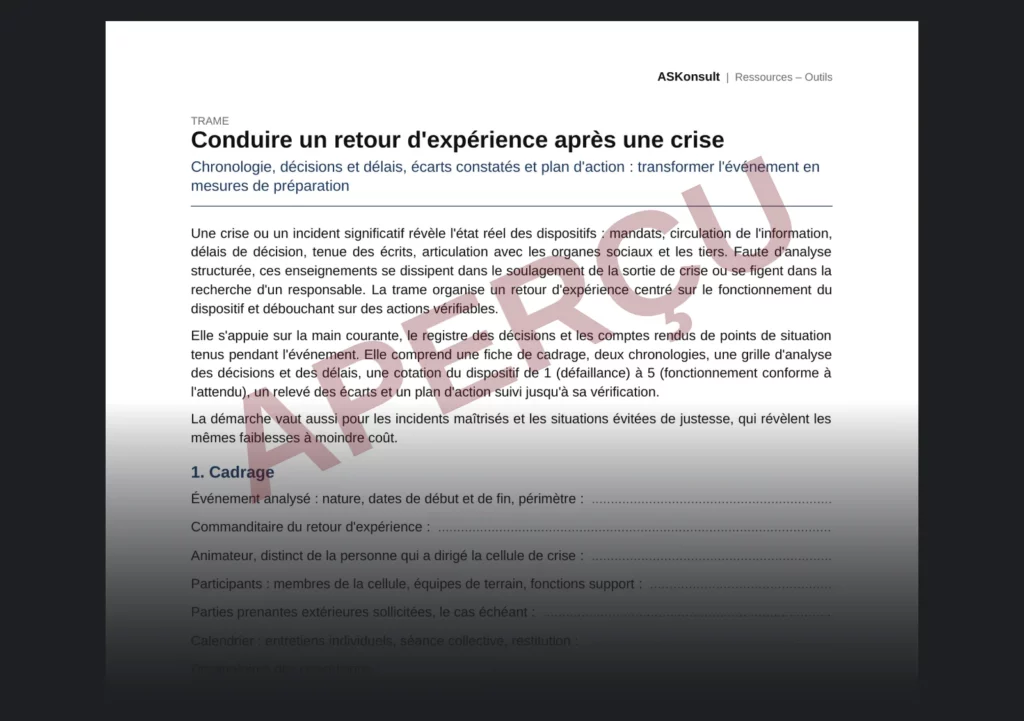
Contents of the template for the lessons-learned review after a crisis
- A scoping sheet: event analysed, commissioning party, facilitator, participants, timetable and rules governing written records.
- Conduct principles and a list of sources: incident log, decision register, system logs, messages issued.
- A chronology of facts and a chronology of knowledge, to measure what the decision-makers knew at each moment.
- One sheet per decision: triggering information, time elapsed, level that decided, options considered, effect observed.
- A rating of the system from 1 (failure) to 5 (functioning as expected), then one sheet per gap identified.
- The running order of the collective session, an action plan with verifiable criteria and a summary for reporting back.
When to undertake the process
The process takes place once the situation has stabilised, within a time frame that preserves the participants’ memory. It also applies to incidents brought under control and to near misses. These events indeed reveal the same weaknesses at lower cost. Executive management and steering committees are its primary users, in particular when they commission the exercise.
Instructions for use
First, the commissioning party approves the scoping and appoints a facilitator other than the person who directed the crisis unit. Next, the team gathers the sources and conducts individual interviews before the collective session. It then establishes the two chronologies, analyses the decisions and rates the system. Finally, the collective session validates the gaps retained and the first lines of action, which the governance body then examines.
Expected outcome
The lessons-learned review after a crisis results in a report that brings together context, chronologies, gaps and action plan. Each action has an owner, a deadline and a verification method: document check, test or exercise. Plans, procedures and templates then undergo a versioned update.
Key facts
| Format | PDF, 4 pages; Word |
|---|---|
| Languages | French |
| Version | October 2026 |
| Departments | Governance & Dispute Resolution |
| Prerequisites | Decision register and chronology |
| Audience | Executive management, steering committees |
Limitations
The template is a methodological aid; it produces neither a legal characterisation of the facts nor an assessment of responsibilities. Furthermore, adaptation to the specific case, the conduct of interviews, review and follow-up fall within consultations and packages. No representation falls within its scope. Finally, the lessons-learned review after a crisis replaces neither the investigations nor the notifications required by the applicable regulations.
Further reading: Governance & Dispute Resolution; ISO 22361:2022, Security and resilience – Crisis management – Guidelines (ISO).
- Prepared by ASKonsult
- Version: octobre 2026
In the same field
Kit · Governance & Dispute Resolution
Activating and running a crisis unit
The kit brings together the documents needed to activate a crisis unit without delay, then to run it through to closure.
Questionnaire · International Trade & Export
Preparing for a supplier due diligence audit
The supplier due diligence audit is prepared before the European buyer makes its request. Large European companies indeed have to address adverse impacts on human rights and the environment among their partners.
Matrix · Governance & Dispute Resolution
Stakeholders and crisis messages
The crisis stakeholder matrix prepares crisis communication ahead of time. In a crisis, the organisation indeed lacks the time to identify whom to inform, in what order and through which channel.
Going further Crisis management consultation: assessment of the event and first decisions
General information document; it constitutes neither legal advice nor an opinion on a particular situation. References to legal texts should be checked against the version in force on the date of use.
Licence of use: internal use by the purchaser, non-exclusive and non-transferable; resale, distribution and making available to third parties excluded (Law No. 2-00).
Consulting firm not registered with the Bar; no representation before the courts and no act reserved to the regulated legal professions.