
Grid · Institutional Advisory & Territorial Engineering
Measuring the value retained by the territory
The value retained by the territory measures the share of the value created that actually stays in place. Indeed, an investment may display high amounts while leaving little value locally. The grid thus rates twenty-three criteria in four families. It then presents a profile, family by family.
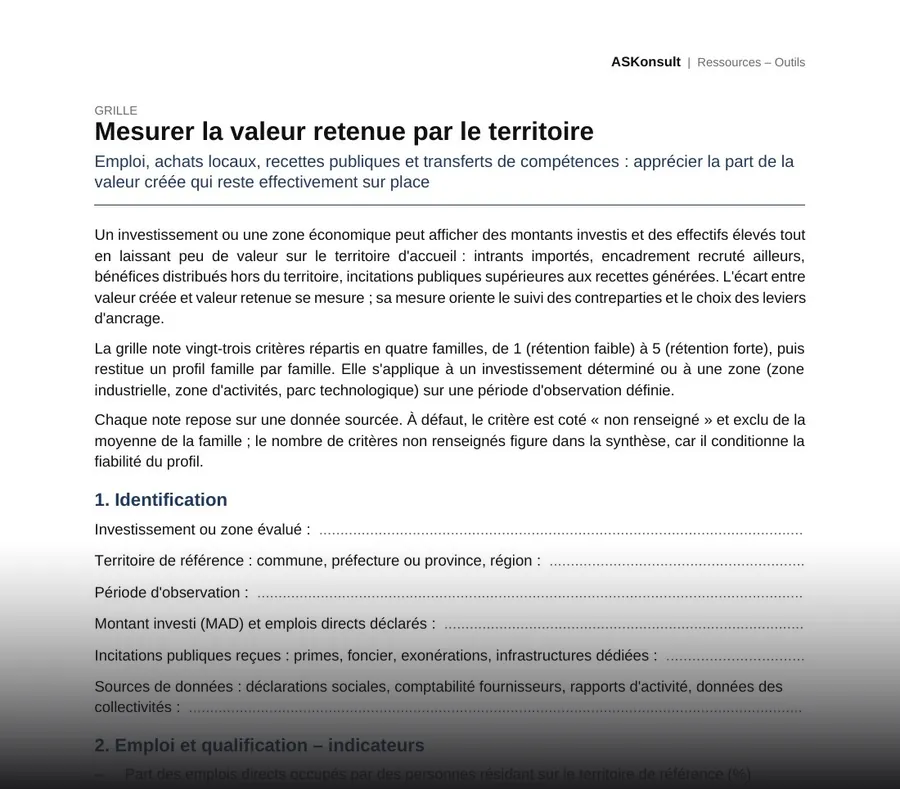
The criteria families for the value retained by the territory
- Identification of the investment or zone.
- Employment and qualifications.
- Local purchasing and subcontracting.
- Tax revenue and public costs.
- Skills transfers.
- Reading of the profile and local anchoring levers.
- Finally, a summary and the applicable references.
When to measure the value retained by the territory
The grid is used first when assessing an investment project. It is also used to monitor the counterpart commitments under an agreement. In addition, it guides the choice of local anchoring levers.
Local authorities and development agencies are among its main intended users. The document also concerns investors attentive to their territorial anchoring.
Instructions for use
The grid is first completed for a specific investment or zone. The grid then rates each criterion from 1 to 5. In addition, the grid flags missing data rather than estimating them. Finally, the reading of the profile guides the anchoring levers and the monitoring of the counterpart commitments provided for in the agreements.
Expected outcome
On completion of the grid, the retention profile appears family by family. The priority anchoring levers appear clearly. As a result, the monitoring of counterpart commitments relies on precise indicators, shared between the investor and public actors.
Key facts
| Format | PDF, 5 pages |
|---|---|
| Languages | French, English, Spanish, Arabic |
| Version | October 2026 |
| Access | download after registration |
| Scope | specific investment or economic zone |
Limitations
The grid does not constitute an economic impact study. Likewise, local data must be collected from the actors concerned. Finally, the document is to be read together with the usage notes and references it contains.
Further reading: public policy advisory; United Nations Conference on Trade and Development.
- Prepared by ASKonsult
- Languages: French, English, Spanish, Arabic
- Version: octobre 2026
In the same field
Checklist · Financial Engineering & Grants
Following up an investment after establishment
Post-establishment investment follow-up keeps to the trajectory set at signature. Indeed, completion of the programme, payment of incentives and justification of jobs extend over several years.
Grid · Institutional Advisory & Territorial Engineering
Measuring the financial and institutional capacity of a local authority
Local authority financial capacity determines whether its programmes can be delivered. Indeed, the 2015 organic laws require an assessment of projected resources and expenditure.
Going further Consultation for local authorities: capacities, prioritisation and programme monitoring
General information document; it constitutes neither legal advice nor an opinion on a particular situation. References to legal texts should be checked against the version in force on the date of use.
Consulting firm not registered with the Bar; no representation before the courts and no act reserved to the regulated legal professions.