
Matrix · Institutional Advisory & Territorial Engineering
Conducting the prioritisation and phasing of territorial projects
This matrix bases territorial project prioritisation and phasing on explicit criteria: impact, maturity, financing capacity. It distinguishes two operations. First, prioritisation determines which projects enter the programme. Second, phasing sets the order and tranches of implementation within the constraint of the foreseeable funding envelope.
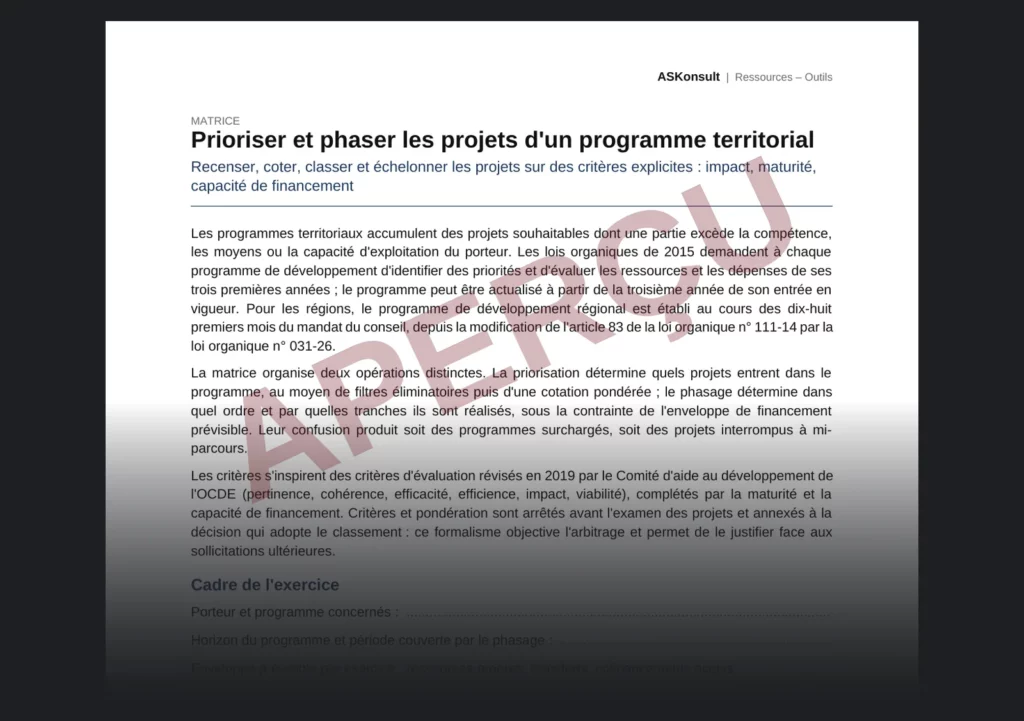
What the territorial project prioritisation matrix contains
- A framework for the exercise: project owner, time horizon, foreseeable envelope per financial year, capacity profile, decision-making body.
- An inventory register: cost, financing plan, maturity, land status, required authorisations.
- Eliminatory filters applied before any rating: competence, link to the diagnostic, land control, feasibility, operation.
- Seven weighted criteria, inspired by the criteria revised in 2019 by the OECD Development Assistance Committee.
- A rating sheet from 1 to 5, the calculation of the weighted score and a rank stability test.
- Multi-year phasing rules, a timetable per tranche and a summary for the decision-making body.
When to use the matrix
The matrix comes into play when a development programme is drawn up or updated. Indeed, the 2015 organic laws require each programme to identify priorities and to assess its resources and expenditure over its first three years. Territorial project prioritisation thus meets this requirement. Local authorities, agencies and public institutions are its users.
Instructions for use
First, the project owner sets the criteria and their weighting before the projects are examined. Next, the owner lists the projects and applies the eliminatory filters. Then the assessors, preferably at least two, rate each project and record how their differences were settled. Finally, phasing divides large-scale projects into self-contained tranches, within the limits of the envelope for each financial year. The summary then goes to the decision-making body.
Expected outcome
The exercise produces a ranked list of the selected projects, the reasons for exclusion and the conditions to be met. It also provides a phasing timetable per financial year. Criteria, weighting and rating sheets, appended to the decision, thus give the decision an objective basis in the face of later requests.
Key facts
| Format | PDF, 4 pages; Word |
|---|---|
| Languages | French |
| Version | October 2026 |
| Departments | Institutional Advisory & Territorial Engineering |
| Prerequisites | List of projects and foreseeable funding envelope |
| Audience | Local authorities, agencies, public institutions |
Limitations
The matrix structures a decision; it replaces neither the deliberation of the competent body nor the procedures laid down by the organic laws. Moreover, a high weighted score does not offset an eliminatory filter that has not been cleared. Adaptation to the specific case, review, validation and follow-up fall within consultations and packages, without representation.
Further reading: Institutional Advisory & Territorial Engineering; Organic Law No. 111-14 on regions (Adala, Ministry of Justice).
- Prepared by ASKonsult
- Version: octobre 2026
In the same field
Template · Institutional Advisory & Territorial Engineering
Structuring a territorial action programme and its monitoring framework
The template structures a territorial action programme, from the shared diagnosis through to the indicators. Such a programme indeed involves several actors, several sources of funding and several years.
Grid · Institutional Advisory & Territorial Engineering
Listing the commitments and contingent liabilities of a public body
Public body contingent liabilities weigh on the finances of the body without appearing in its budget.
Checklist · Financial Engineering & Grants
Following up an investment after establishment
Post-establishment investment follow-up keeps to the trajectory set at signature. Indeed, completion of the programme, payment of incentives and justification of jobs extend over several years.
Going further Consultation for local authorities: capacities, prioritisation and programme monitoring
General information document; it constitutes neither legal advice nor an opinion on a particular situation. References to legal texts should be checked against the version in force on the date of use.
Licence of use: internal use by the purchaser, non-exclusive and non-transferable; resale, distribution and making available to third parties excluded (Law No. 2-00).
Consulting firm not registered with the Bar; no representation before the courts and no act reserved to the regulated legal professions.