
Checklist · Information Systems & Digital Transformation
Checking the compliance of AI uses
For each use of artificial intelligence, this list sets out the checks on the compliance of AI uses under three frameworks. These are Law No. 09-08, the GDPR and the EU AI Act. The two European texts, however, apply according to the exposure of the organisation to the Union. Each use thus receives a characterisation, dated checks and follow-up.
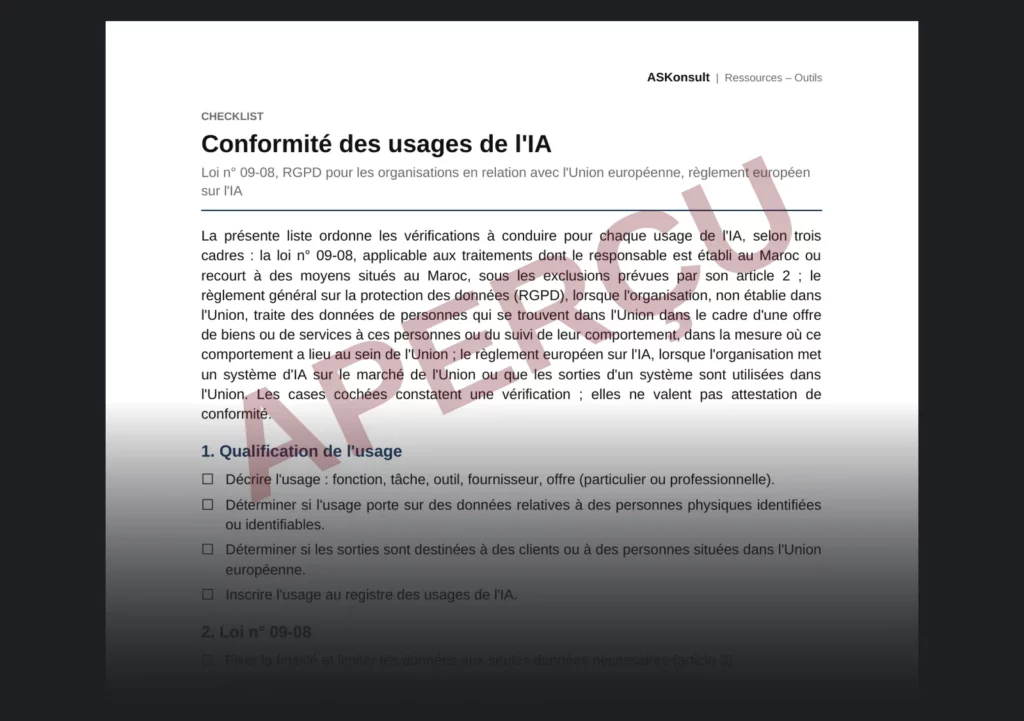
What the checklist on the compliance of AI uses contains
- Characterisation of the use: function, task, tool, provider, plan, data on identifiable persons, outputs intended for the European Union.
- Law No. 09-08: purpose and necessary data, legal basis, information, rights, automated decision, formality, contract with the provider, transfer.
- GDPR: territorial scope, representative in the Union, legal basis and information, processing agreement, transfers outside the Union.
- EU AI Act: role of the organisation, prohibited practices, transparency, AI literacy of staff, high-risk classification.
- The high-risk timetable: 2 December 2027 for Annex III, 2 August 2028 for Annex I.
- Finally, follow-up: dated checks, designated author, re-examination at each change of tool, provider or terms.
When to use the checklist
The list applies to each AI use, from its entry in the register of uses. It is then repeated at each change of tool, provider or terms. It concerns first of all data controllers established in Morocco or using means located in Morocco. It also covers organisations dealing with the European Union, under the GDPR or the AI Act.
Instructions for use
First, the characterisation describes the use and determines whether it involves data on identifiable persons. Next, the Law No. 09-08 checks are carried out article by article, from purpose to transfer. Then the GDPR and EU AI Act sections are opened only if the organisation falls within their scope. Finally, each check receives a date and an author. Follow-up on the compliance of AI uses then incorporates the deliberation announced by the National Commission for the Control of Personal Data Protection (CNDP) on such processing.
Expected outcome
The result is a dated list of checks on the compliance of AI uses, framework by framework. It thus brings out the open points: legal basis, formality with the CNDP, contract, transfers. Each check also refers to the relevant article of the text concerned.
Key facts
| Format | PDF, 3 pages; Word |
|---|---|
| Languages | French |
| Version | October 2026 |
| Departments | Information Systems & Digital Transformation |
| Prerequisites | Description of the use: function, task, tool, provider, plan |
| Audience | Organisations using AI, in Morocco or dealing with the European Union |
Limitations
The list records checks; it does not amount to a certificate of compliance. Moreover, references to legal texts must be checked against the wording in force on the date of use. In addition, the formality, the basis for a transfer and high-risk classification depend on each use.
Further reading: Information Systems & Digital Transformation; Law No. 09-08 on the protection of individuals with regard to the processing of personal data.
- Prepared by ASKonsult
- Version: octobre 2026
In the same field
Register · Information Systems & Digital Transformation
Keeping the register of AI uses
Uses of artificial intelligence often spread without any inventory; the register of AI uses lists them. It documents, for each use, the information relevant to its governance.
Grid · Information Systems & Digital Transformation
Assessing an AI provider and comparing up to three offerings
Choosing an artificial intelligence offering commits the data of the organisation; the grid serves for assessing an AI provider.
Template · Information Systems & Digital Transformation
Adopting and applying a corporate AI charter
To govern artificial intelligence tools, the corporate AI charter sets common rules for all users. It applies to employees, interns, corporate officers and service providers working on the systems.
Going further Consultation on AI use in business: framing tools and data
General information document; it constitutes neither legal advice nor an opinion on a particular situation. References to legal texts should be checked against the version in force on the date of use.
Licence of use: internal use by the purchaser, non-exclusive and non-transferable; resale, distribution and making available to third parties excluded (Law No. 2-00).
Consulting firm not registered with the Bar; no representation before the courts and no act reserved to the regulated legal professions.