
Grid · Information Systems & Digital Transformation
Assessing an AI provider and comparing up to three offerings
Choosing an artificial intelligence offering commits the data of the organisation; the grid serves for assessing an AI provider. It compares up to three offerings against twenty criteria in six families: data, location, contract, security, use and cost. The rating is in fact based on the published and contractual terms of the providers. Three eliminatory criteria also rule out offerings unsuited to personal and confidential data.
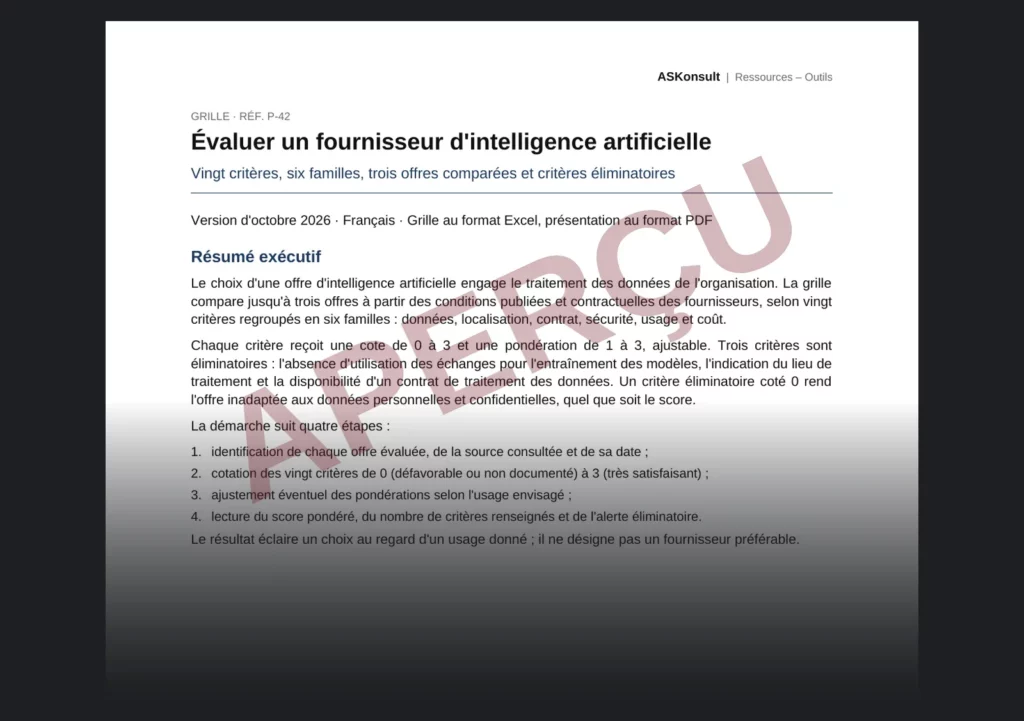
What the grid for assessing an AI provider contains
- A “How to use” tab: purpose, rating scale, eliminatory criteria rule, reading of the result, update frequency.
- A “Grid” tab: twenty criteria in six families, data (4), location (3), contract (4), security (4), use (3), cost (2).
- Location criteria: place of processing stated, processing possible in a State on the list of the National Commission for the Control of Personal Data Protection (CNDP), sub-processors published.
- A score from 0 to 3 per criterion and an adjustable weight from 1 to 3, selected from drop-down lists.
- Three eliminatory criteria marked “E”: no use of exchanges for training, place of processing stated, data processing agreement.
- Finally, three calculated results per offering: weighted score as a percentage, number of criteria completed, eliminatory alert.
When to use the grid
The grid is used before choosing an AI offering intended to process data of the organisation. It also makes it possible to assess an AI provider against two other offerings, for the same use. Moreover, provider terms change frequently; the assessment is therefore renewed at each change to the published or contractual terms. It is aimed in particular at organisations selecting an AI offering for personal or confidential data.
Instructions for use
First, the “Grid” tab receives, for each offering, its name, the source consulted and its date. Next, each criterion receives a score from 0, unfavourable or undocumented, to 3, highly satisfactory. Then the weightings in column C are adjusted, if necessary, according to the intended use. Finally, the reading focuses on the weighted score, the number of criteria completed and the eliminatory alert.
Expected outcome
Assessing an AI provider with the grid produces a weighted score per offering, expressed as a percentage. The score appears once all twenty criteria have been rated; an eliminatory criterion rated 0, however, triggers an alert. Finally, the number of criteria completed is displayed for each offering.
Key facts
| Format | Excel workbook; PDF presentation, 3 pages |
|---|---|
| Languages | French |
| Version | October 2026 |
| Departments | Information Systems & Digital Transformation |
| Prerequisites | Published and contractual terms of the offerings assessed |
| Audience | Organisations choosing an AI offering |
Limitations
The grid does not designate a preferable provider: the score depends on the intended use and the weightings selected. In addition, each assessment is valid as of its date, since provider terms change frequently. A decision-support tool, to be adapted to the organisation and the intended use.
Further reading: Information Systems & Digital Transformation; List of States ensuring adequate protection of personal data (CNDP).
- Prepared by ASKonsult
- Version: octobre 2026
In the same field
Checklist · Information Systems & Digital Transformation
Checking the compliance of AI uses
For each use of artificial intelligence, this list sets out the checks on the compliance of AI uses under three frameworks. These are Law No. 09-08, the GDPR and the EU AI Act.
Model clauses · Information Systems & Digital Transformation
Incorporating AI model clauses into contracts and internal procedures
Governing artificial intelligence in writing requires precise provisions: AI model clauses provide the frameworks for them.
Checklist · Information Systems & Digital Transformation
Security of AI uses
The security checklist for AI use orders the controls specific to generative AI tools. These controls are carried out before and during use. They thus cover accounts, data, hidden instructions, extensions and incidents.
Going further Consultation on AI use in business: framing tools and data
General information document; it constitutes neither legal advice nor an opinion on a particular situation. References to legal texts should be checked against the version in force on the date of use.
Licence of use: internal use by the purchaser, non-exclusive and non-transferable; resale, distribution and making available to third parties excluded (Law No. 2-00).
Consulting firm not registered with the Bar; no representation before the courts and no act reserved to the regulated legal professions.