
Register · Information Systems & Digital Transformation
Keeping the register of AI uses
Uses of artificial intelligence often spread without any inventory; the register of AI uses lists them. It documents, for each use, the information relevant to its governance. Where applicable, it also serves the formalities provided for by Law No. 09-08. An alert column also flags the rows that call for review.
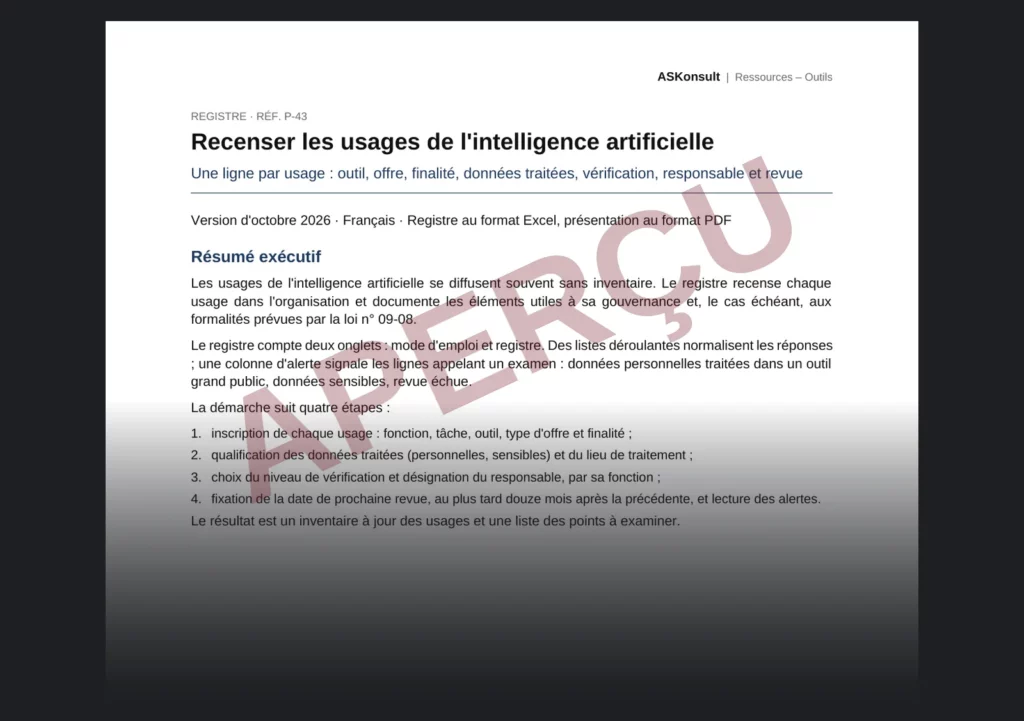
What the register of AI uses contains
- A “How to use” tab: purpose of the register, completion rules, data processing and review frequency.
- A “Register” tab of two hundred rows, at one row per use.
- The columns: function, task, tool, purpose, place of processing, person responsible designated by function, date of entry, next review.
- Drop-down lists: consumer, professional or internal offering; personal and sensitive data, yes or no; level N1, N2 or N3.
- A calculated alert: personal data in a consumer tool, sensitive data with authorisation from the National Commission for the Control of Personal Data Protection (CNDP) to be examined, review overdue.
- Finally, white cells for input and greyed-out calculated cells.
When to keep the register
The register accompanies each new AI use in the organisation, to be entered on a dedicated row. It is then used at each review, no later than twelve months after the previous one. Moreover, it informs the formalities provided for by Law No. 09-08, particularly when sensitive data are involved. It is aimed at organisations that inventory their AI uses and organise their governance.
Instructions for use
First, each use receives a row in the register of AI uses: function, task, tool, type of offering and purpose. Next, the drop-down lists qualify the data processed, personal or sensitive, then the place of processing is entered. The verification level and the person responsible, designated by function, then complete the row. Finally, the next review date is set no later than twelve months after the previous one, and the alerts are read.
Expected outcome
The register of AI uses provides an up-to-date inventory of uses and a list of points to examine. Each alert thus points to a specific review: consumer tool, CNDP authorisation or overdue review.
Key facts
| Format | Excel workbook; PDF presentation, 3 pages |
|---|---|
| Languages | French |
| Version | October 2026 |
| Departments | Information Systems & Digital Transformation |
| Prerequisites | List of uses, tools and persons responsible, designated by function |
| Audience | Organisations that inventory their AI uses |
Limitations
The register designates persons by function; it contains no personal data on clients, service users or employees. In addition, the sensitive data alert flags a review to be carried out, without determining the applicable formality. A management-support tool, to be adapted to the organisation and the applicable regulations.
Further reading: Information Systems & Digital Transformation; Law No. 09-08 on the protection of individuals with regard to the processing of personal data.
- Prepared by ASKonsult
- Version: octobre 2026
In the same field
Template · Information Systems & Digital Transformation
Adopting and applying a corporate AI charter
To govern artificial intelligence tools, the corporate AI charter sets common rules for all users. It applies to employees, interns, corporate officers and service providers working on the systems.
Checklist · Information Systems & Digital Transformation
Checking the compliance of AI uses
For each use of artificial intelligence, this list sets out the checks on the compliance of AI uses under three frameworks. These are Law No. 09-08, the GDPR and the EU AI Act.
Bundle · Information Systems & Digital Transformation
Choosing and combining the three AI use charters
To govern artificial intelligence tools, the bundle brings together three AI use charters: company, association and public body.
Going further Consultation on AI use in business: framing tools and data
General information document; it constitutes neither legal advice nor an opinion on a particular situation. References to legal texts should be checked against the version in force on the date of use.
Licence of use: internal use by the purchaser, non-exclusive and non-transferable; resale, distribution and making available to third parties excluded (Law No. 2-00).
Consulting firm not registered with the Bar; no representation before the courts and no act reserved to the regulated legal professions.