
Template · Information Systems & Digital Transformation
Adopting an AI charter for associations
To govern artificial intelligence tools, the AI charter for associations sets shared rules of use. It applies to members of the governing bodies, employees, volunteers and members acting on behalf of the association. It protects in particular the data of members, beneficiaries and donors. The template is then adopted by the competent body, in accordance with the articles of association.
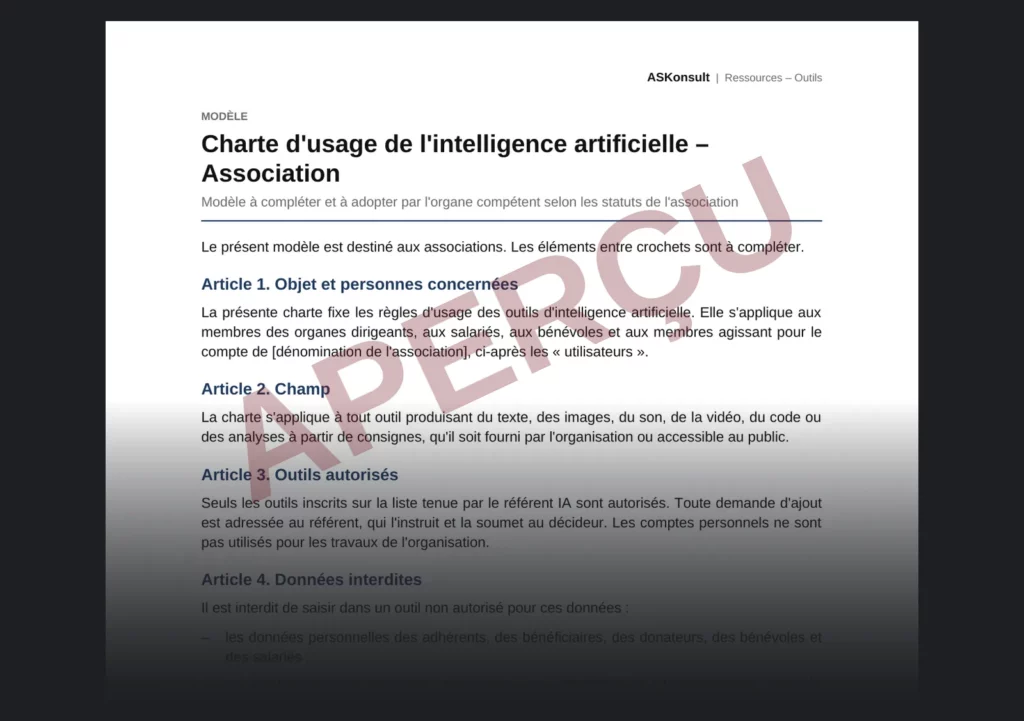
What the AI charter for associations contains
- Purpose, persons concerned and scope, from the governing bodies to volunteers.
- The authorised tools, then the prohibited data: members, beneficiaries, donors, health, opinions, beliefs or trade union membership.
- Excluded uses: no admission, award of assistance or selection of a beneficiary decided by a tool alone.
- Three levels of human verification, from simple proofreading to validation by an authorised person.
- Specific rules: formality with the National Commission for the Control of Personal Data Protection (CNDP) for beneficiary data and N3 validation of reports and funding applications.
- Also, transparency, register, security, officer, decision-maker, adoption, review and references to Law No. 09-08 and Regulation (EU) 2024/1689.
When to adopt the charter
The charter is adopted as soon as employees or volunteers use AI tools for the work of the association. It is used in particular before processing beneficiary data by such means or preparing a funding application. Moreover, it is reviewed at least once a year and at each significant change of tool or regulation. It thus concerns the executive committee, the board of directors, the AI officer, employees and volunteers.
Instructions for use
First, the association appoints the AI officer and the decision-maker, the president or a member of the executive committee. Next, it completes the items in square brackets and draws up the list of authorised tools. Then the executive committee, the board of directors or the general assembly adopts the AI charter for associations, in accordance with the articles of association. Finally, each user, employee or volunteer, acknowledges having read it, and the officer organises awareness-raising.
Expected outcome
The association has a charter adopted by the competent body and acknowledged by each user. The data of members and beneficiaries thus fall within an explicit framework. Documents submitted to funders also go through N3-level validation.
Key facts
| Format | PDF, 3 pages; Word |
|---|---|
| Languages | French |
| Version | October 2026 |
| Departments | Information Systems & Digital Transformation |
| Prerequisites | Articles of association; appointment of the AI officer and the decision-maker |
| Audience | Associations: executive committee, board of directors, AI officer, employees and volunteers |
Limitations
The template verifies neither the applicable formality with the CNDP nor the authorisation regime for sensitive data; this verification is a matter for the association. Moreover, references to legal texts must be checked against the wording in force on the date of use. The firm provides no representation before the courts.
Further reading: Information Systems & Digital Transformation; Law No. 09-08 on the protection of individuals with regard to the processing of personal data.
- Prepared by ASKonsult
- Version: octobre 2026
In the same field
Register · Information Systems & Digital Transformation
Keeping the register of AI uses
Uses of artificial intelligence often spread without any inventory; the register of AI uses lists them. It documents, for each use, the information relevant to its governance.
Checklist · Information Systems & Digital Transformation
Checking the compliance of AI uses
For each use of artificial intelligence, this list sets out the checks on the compliance of AI uses under three frameworks. These are Law No. 09-08, the GDPR and the EU AI Act.
Guide · Information Systems & Digital Transformation
Good and bad practices for generative AI at work
Good practices for generative AI at work come down to a few rules applicable to any tool. They thus precede the adoption of a use charter specific to the organisation.
Going further Consultation on AI use in business: framing tools and data
General information document; it constitutes neither legal advice nor an opinion on a particular situation. References to legal texts should be checked against the version in force on the date of use.
Licence of use: internal use by the purchaser, non-exclusive and non-transferable; resale, distribution and making available to third parties excluded (Law No. 2-00).
Consulting firm not registered with the Bar; no representation before the courts and no act reserved to the regulated legal professions.