
Template · Information Systems & Digital Transformation
Drafting flash meeting minutes
Flash meeting minutes record decisions, actions, their owners and their deadlines. They do not recount the discussions. Circulated quickly, they thus fix commitments while the meeting is still fresh in participants’ minds. They then serve as the basis for the next review and ensure the traceability of the decisions of a committee or a project.
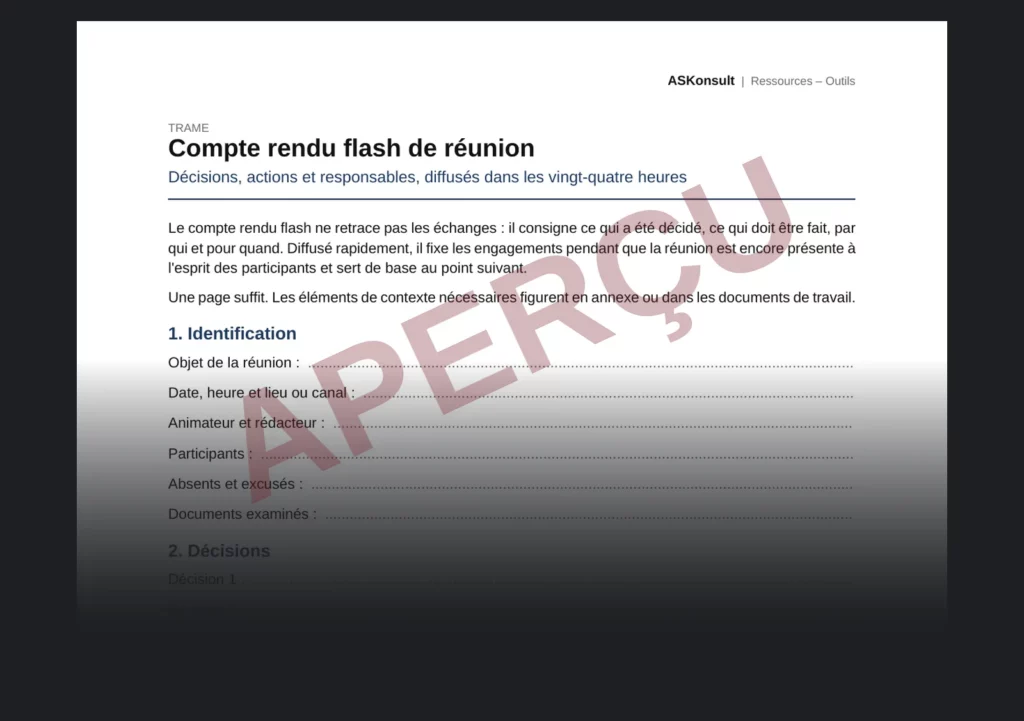
What the flash meeting minutes contain
- Identification: subject, date, venue or channel, facilitator, drafter, participants, absentees and documents reviewed.
- Decisions taken, one decision per line.
- Actions, each associated with an owner and a deadline.
- Pending items, with the reason and the information or arbitration awaited.
- Next steps: date and subject of the next meeting, then the distribution list.
- Rules for drafting, circulation and carrying over overdue actions.
When to use the template
The template is suitable, in particular, for committees and project meetings. It is thus intended for project managers, committee secretariats and local authorities. Indeed, flash meeting minutes differ from a record of discussions: they record only decisions and commitments. One page is therefore sufficient. Any necessary background information then appears in an annex or in the working documents.
Instructions for use
The drafter first prepares the identification section from the agenda. The drafter then words each decision with a verb in the infinitive or the past tense. Next, the drafter associates each action with a named owner and a date. Finally, the drafter circulates the document within twenty-four hours. Participants then have forty-eight hours to submit their comments.
Expected outcome
The document thus fits on one page. It provides a record of commitments, without opinions or assessments of participants. In addition, the next meeting opens with a review of overdue actions.
Key facts
| Format | PDF, 2 pages; Word |
|---|---|
| Languages | French |
| Version | October 2026 |
| Departments | Information Systems & Digital Transformation; Institutional Advisory & Territorial Engineering |
| Prerequisites | Meeting agenda |
| Audience | Project managers, committee secretariats, local authorities |
Limitations
The template covers neither adaptation to the specific case, nor review, nor validation, nor follow-up, which fall within consultations and packages. Nor does it recount the detail of the discussions.
Further reading: Information Systems & Digital Transformation.
- Prepared by ASKonsult
- Version: octobre 2026
In the same field
Template · Institutional Advisory & Territorial Engineering
Structuring a territorial action programme and its monitoring framework
The template structures a territorial action programme, from the shared diagnosis through to the indicators. Such a programme indeed involves several actors, several sources of funding and several years.
Template · Information Systems & Digital Transformation
Making decisions on a digital project portfolio
This template organises decision-making on a digital project portfolio on a consistent basis.
Checklist · Information Systems & Digital Transformation
Security of AI uses
The security checklist for AI use orders the controls specific to generative AI tools. These controls are carried out before and during use. They thus cover accounts, data, hidden instructions, extensions and incidents.
Going further Organisation and management consultation: roles, delegation and recruitment
General information document; it constitutes neither legal advice nor an opinion on a particular situation. References to legal texts should be checked against the version in force on the date of use.
Licence of use: internal use by the purchaser, non-exclusive and non-transferable; resale, distribution and making available to third parties excluded (Law No. 2-00).
Consulting firm not registered with the Bar; no representation before the courts and no act reserved to the regulated legal professions.