
Template · Information Systems & Digital Transformation
Making decisions on a digital project portfolio
This template organises decision-making on a digital project portfolio on a consistent basis. Without a common basis, the decision-making body in fact decides on the conviction of project sponsors rather than on value, full cost and risk. The template combines one sheet per project with a summary table that ranks the portfolio.
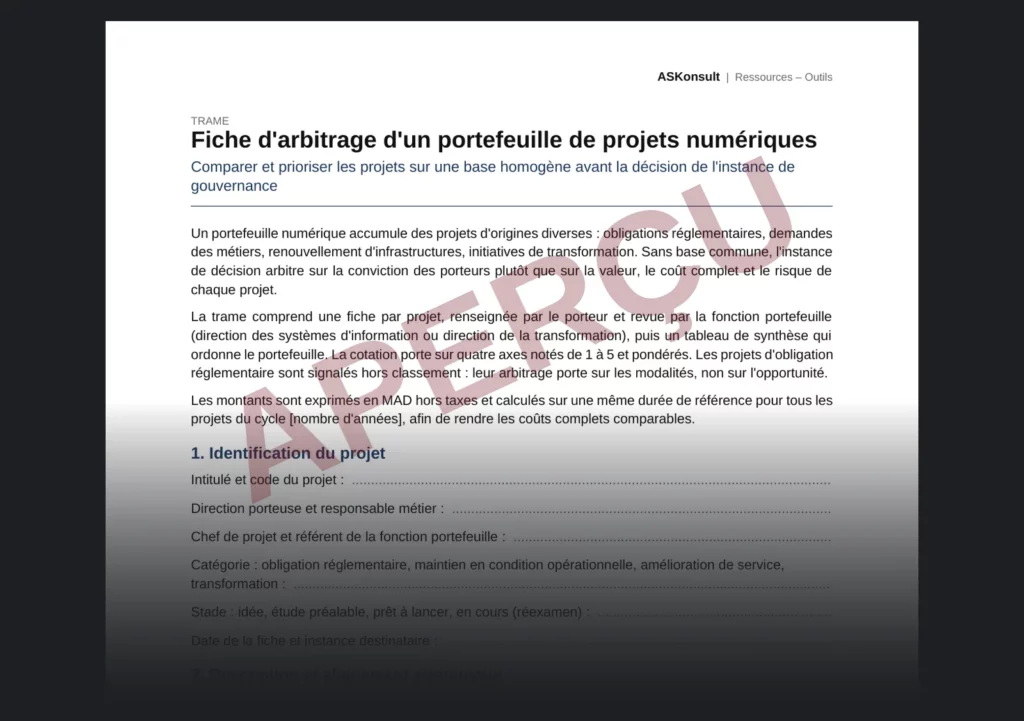
What the digital project portfolio decision sheet contains
- Project identification: sponsoring department, category, stage, receiving body.
- Description and strategic alignment, rated on axis A.
- Investment and operating costs, benefits and dependencies, rated on axis B.
- Risks and prerequisites, particularly with regard to Laws No. 09-08 and No. 05-20, rated on axis C.
- Urgency on axis D, calculation of the weighted score, threshold rules and the proposed decision.
- The portfolio summary table and the operating rules of the body.
When to use the template
The template is used in each decision cycle, when projects of various origins compete for the same envelope. These include regulatory obligations, business requests, infrastructure renewals and transformation initiatives. It is also used to review ongoing projects. IT departments, public bodies and transformation departments are its users.
Instructions for use
First, the body sets the weightings before the sheets are examined; they remain the same for the whole cycle. Next, each sponsor completes their sheet, then the portfolio function reviews it. A sheet with unsourced figures is then returned to the sponsor before rating. Finally, the summary table compares the ranking with the budget envelope and team capacity.
Expected outcome
The body has a digital project portfolio ranked by weighted score. Projects arising from regulatory obligations appear at the top, outside the ranking. Each sheet carries a proposal: launch, launch subject to conditions, resize, postpone or abandon.
Key facts
| Format | PDF, 4 pages; Word |
|---|---|
| Languages | French |
| Version | October 2026 |
| Departments | Information Systems & Digital Transformation |
| Prerequisites | List of projects and projected budgets |
| Audience | IT departments, public bodies, transformation departments |
Limitations
The template structures the decision; it replaces neither the feasibility study nor the legal analysis of a project. Moreover, the proposed weightings remain indicative. Adaptation to a specific organisation, review and follow-up of decisions fall within consultations and packages, without representation.
Further reading: Information Systems & Digital Transformation; ISO 21504:2022, Project, programme and portfolio management – Guidance on portfolio management (ISO).
- Prepared by ASKonsult
- Version: octobre 2026
In the same field
Template · Information Systems & Digital Transformation
Drafting flash meeting minutes
Flash meeting minutes record decisions, actions, their owners and their deadlines. They do not recount the discussions.
Checklist · Information Systems & Digital Transformation
Security of AI uses
The security checklist for AI use orders the controls specific to generative AI tools. These controls are carried out before and during use. They thus cover accounts, data, hidden instructions, extensions and incidents.
Guide · Information Systems & Digital Transformation
Good and bad practices for generative AI at work
Good practices for generative AI at work come down to a few rules applicable to any tool. They thus precede the adoption of a use charter specific to the organisation.
Going further Information systems consultation: scoping a digital project, from need to options
General information document; it constitutes neither legal advice nor an opinion on a particular situation. References to legal texts should be checked against the version in force on the date of use.
Licence of use: internal use by the purchaser, non-exclusive and non-transferable; resale, distribution and making available to third parties excluded (Law No. 2-00).
Consulting firm not registered with the Bar; no representation before the courts and no act reserved to the regulated legal professions.