
Template · Institutional Advisory & Territorial Engineering
Structuring a territorial action programme and its monitoring framework
The template structures a territorial action programme, from the shared diagnosis through to the indicators. Such a programme indeed involves several actors, several sources of funding and several years. Its credibility therefore depends on traceability between diagnosis, objectives, projects, resources and measured results. Without a monitoring framework, it is thus reduced to a list of intentions.
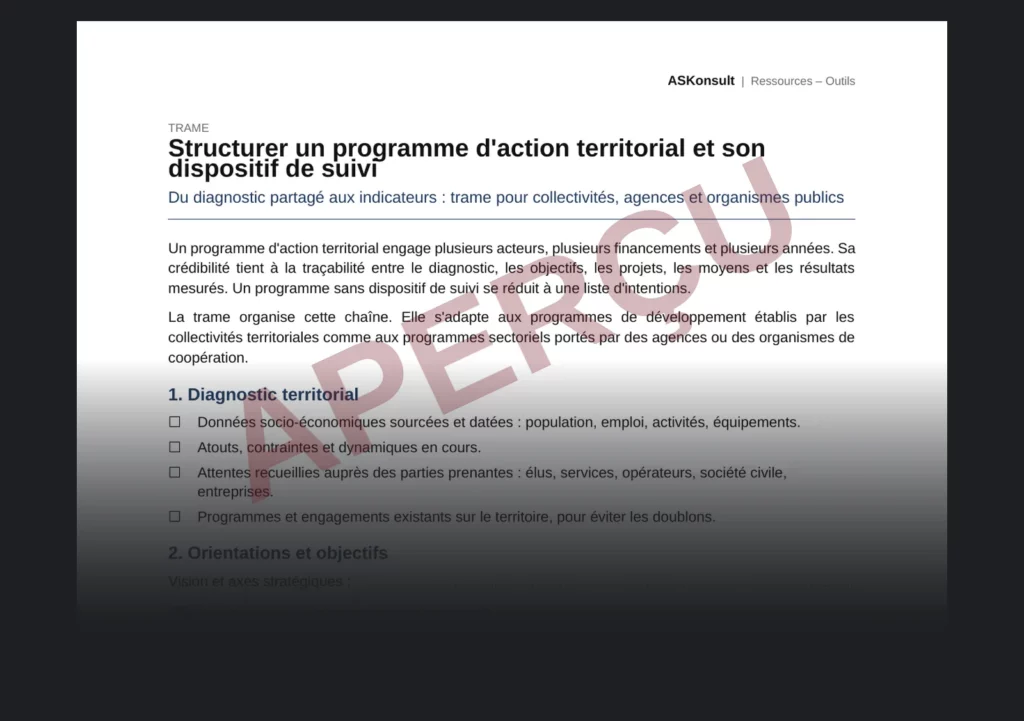
Contents of the template
- Territorial diagnosis: sourced and dated socio-economic data, strengths, constraints, stakeholder expectations, existing programmes.
- Orientations and objectives: vision, strategic axes, measurable objectives, impact indicators, consistency with national and regional strategies.
- Project sheets: axis, location, project owner, partners, cost, financing plan, timetable, indicators, risks and prerequisites.
- Governance: steering body, technical committee, focal points per project, partnership and financing agreements, revision procedure.
- Monitoring and evaluation: quarterly dashboard, collection of indicators, annual report, mid-term and final evaluations, public reporting.
- Finally, notes on use and references to the organic laws on regions, on prefectures and provinces and on communes.
When to structure a territorial action programme
The template adapts to development programmes drawn up by local authorities. It is also suited to sectoral programmes led by agencies or cooperation bodies. It is used as soon as the diagnosis has been summarised, before projects are selected. Furthermore, it links each project to its project owner, its partners and its financing plan. It is intended in particular for local authorities, agencies and public establishments.
Instructions for use
First, the available diagnosis is summarised, with sourced and dated data. Next, the vision is broken down into axes, then into measurable objectives with impact indicators. Each project then receives its sheet: project owner, cost, financing, timetable and risks. Finally, governance and the monitoring framework are set, from the steering body through to public reporting.
Expected outcome
The result is a territorial action programme that is traceable from diagnosis to measured results. Each indicator thus has a baseline value and a dated target. In addition, the quarterly dashboard tracks the physical and financial progress of each project.
Key facts
| Format | PDF, 2 pages; Word |
|---|---|
| Languages | French |
| Version | October 2026 |
| Departments | Institutional Advisory & Territorial Engineering |
| Prerequisites | Territorial diagnosis available |
| Audience | Local authorities, agencies, public establishments |
Limitations
The template does not establish the diagnosis and covers neither adaptation to the specific case, nor review, nor validation, nor follow-up. These services fall within consultations and packages; the template includes no representation. In addition, the drawing up, adoption and revision of programmes are governed by the texts specific to each level of local authority.
Further reading: Institutional Advisory & Territorial Engineering; Organic Law No. 111-14 on regions.
- Prepared by ASKonsult
- Version: octobre 2026
In the same field
Matrix · Institutional Advisory & Territorial Engineering
Conducting the prioritisation and phasing of territorial projects
This matrix bases territorial project prioritisation and phasing on explicit criteria: impact, maturity, financing capacity. It distinguishes two operations.
Grid · Institutional Advisory & Territorial Engineering
Listing the commitments and contingent liabilities of a public body
Public body contingent liabilities weigh on the finances of the body without appearing in its budget.
Checklist · Financial Engineering & Grants
Following up an investment after establishment
Post-establishment investment follow-up keeps to the trajectory set at signature. Indeed, completion of the programme, payment of incentives and justification of jobs extend over several years.
Going further Consultation for local authorities: capacities, prioritisation and programme monitoring
General information document; it constitutes neither legal advice nor an opinion on a particular situation. References to legal texts should be checked against the version in force on the date of use.
Licence of use: internal use by the purchaser, non-exclusive and non-transferable; resale, distribution and making available to third parties excluded (Law No. 2-00).
Consulting firm not registered with the Bar; no representation before the courts and no act reserved to the regulated legal professions.