
Template · Information Systems & Digital Transformation
Adopting and applying a corporate AI charter
To govern artificial intelligence tools, the corporate AI charter sets common rules for all users. It applies to employees, interns, corporate officers and service providers working on the systems. It thus defines the authorised tools, the prohibited data and the excluded uses. In addition, it grades human verification according to how the generated content is used.
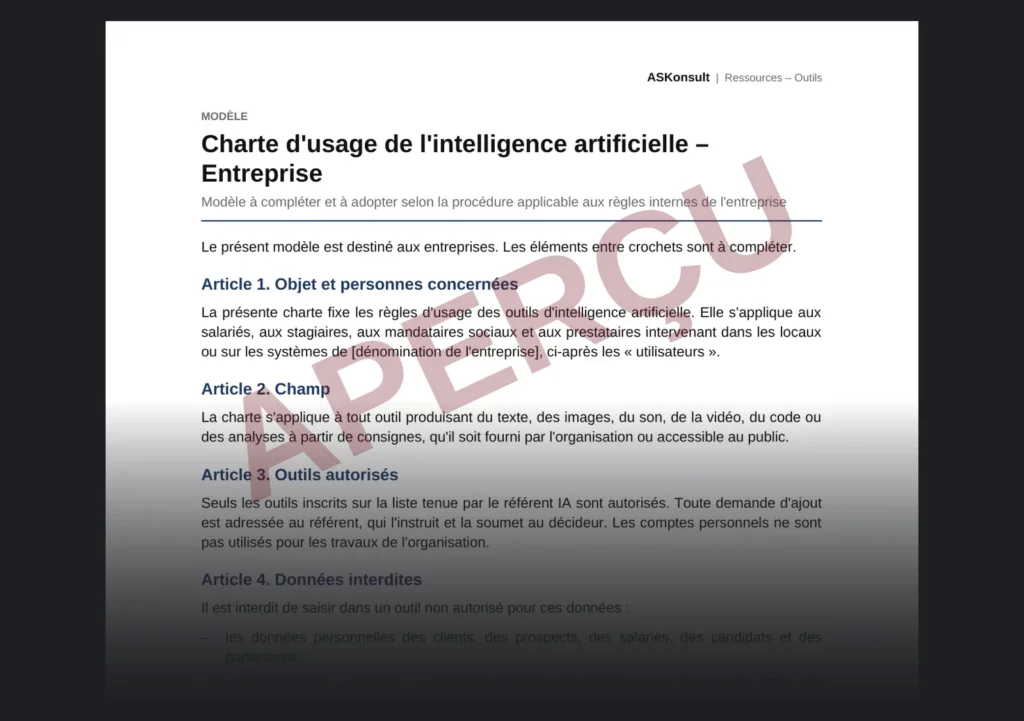
What the corporate AI charter template contains
- Purpose, persons concerned and scope: any tool producing text, images, sound, video, code or analyses.
- The authorised tools, entered on a list kept by the AI officer, then the prohibited data and the excluded uses.
- Three levels of human verification: proofreading, fact-checking and validation by an authorised person.
- Specific rules: N3 validation of information provided to clients and an AI clause for service providers.
- Transparency, register of uses, security and incidents, officer and decision-maker, adoption and review.
- Finally, references to the Labour Code, Laws No. 09-08 and No. 31-08 and Regulation (EU) 2024/1689.
When to adopt the charter
The corporate AI charter is adopted as soon as AI tools enter the work of the organisation. It is used in particular before opening a chatbot to clients or engaging a service provider that uses these tools. Moreover, its review takes place at least once a year and at each significant change of tool or regulation. It therefore concerns management, the AI officer and all users.
Instructions for use
First, management appoints the AI officer and the decision-maker, then completes the items in square brackets. Next, the officer draws up the list of authorised tools and opens the register of uses. The text then follows the applicable procedure: from ten regular employees, it is incorporated into or appended to the internal regulations. Finally, the officer organises awareness-raising and reports to the decision-maker at least once a year.
Expected outcome
The company has an adopted charter, known to users and open to revision. Each AI use falls within a framework: authorised tool, permitted data, verification level and person responsible. The register of uses also ensures traceability.
Key facts
| Format | PDF, 3 pages; Word |
|---|---|
| Languages | French |
| Version | October 2026 |
| Departments | Information Systems & Digital Transformation |
| Prerequisites | Appointment of the AI officer and the decision-maker; internal regulations, where applicable |
| Audience | Companies: management, AI officer, users |
Limitations
The template sets a general framework; it does not characterise any particular situation and does not replace the adoption formalities specific to the company. Moreover, references to legal texts must be checked against the wording in force on the date of use. The firm provides no representation before the courts.
Further reading: Information Systems & Digital Transformation; Law No. 09-08 on the protection of individuals with regard to the processing of personal data.
- Prepared by ASKonsult
- Version: octobre 2026
In the same field
Register · Information Systems & Digital Transformation
Keeping the register of AI uses
Uses of artificial intelligence often spread without any inventory; the register of AI uses lists them. It documents, for each use, the information relevant to its governance.
Checklist · Information Systems & Digital Transformation
Checking the compliance of AI uses
For each use of artificial intelligence, this list sets out the checks on the compliance of AI uses under three frameworks. These are Law No. 09-08, the GDPR and the EU AI Act.
Model clauses · Information Systems & Digital Transformation
Incorporating AI model clauses into contracts and internal procedures
Governing artificial intelligence in writing requires precise provisions: AI model clauses provide the frameworks for them.
Going further Consultation on AI use in business: framing tools and data
General information document; it constitutes neither legal advice nor an opinion on a particular situation. References to legal texts should be checked against the version in force on the date of use.
Licence of use: internal use by the purchaser, non-exclusive and non-transferable; resale, distribution and making available to third parties excluded (Law No. 2-00).
Consulting firm not registered with the Bar; no representation before the courts and no act reserved to the regulated legal professions.