
Library · Information Systems & Digital Transformation
Equipping each department with a prompt library by function
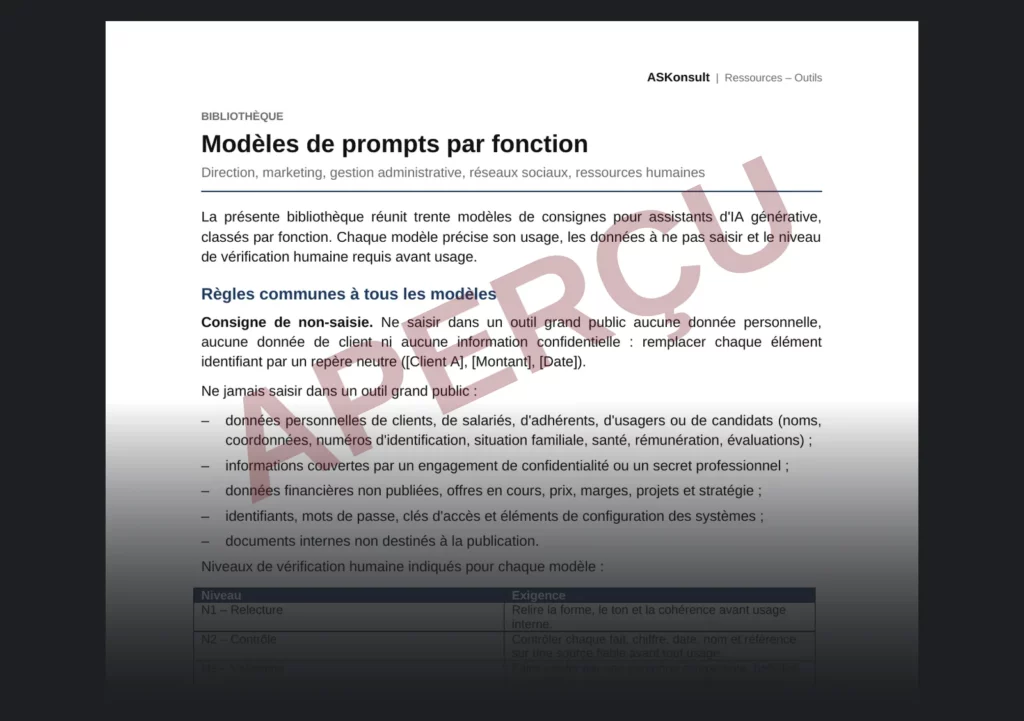
The prompt library by function brings together thirty instruction templates for generative artificial intelligence assistants. It classifies them into five functions: management, marketing, administrative management, social media and human resources. Each template specifies its use, the data not to be entered and the level of human verification required. AI uses thus rest on rules common to the whole organisation.
What the prompt library by function contains
- Common rules: no-entry instruction, neutral placeholders such as [Client A] or [Date], list of excluded information.
- Three verification levels: proofreading (N1), checking (N2) and validation (N3), spread equally across the templates.
- Management and marketing: twelve templates, from the decision note to the product sheet and translation.
- Administrative management: six templates, including the standard letter, the internal procedure, minutes and the list of documents.
- Social media: six templates, including adaptation by network, hooks and replying to a comment.
- Finally, human resources: six templates, from the job description to the staff information note.
When to use the library
The library is used when an organisation rolls out generative AI assistants across several departments at once. It then provides each function with consistent instructions, with the same no-entry and verification rules. It is also used to set, for each task, the expected level of human control. It is aimed in particular at management and the heads of the departments concerned.
Instructions for use
First, each department identifies the templates for its function. Next, the user copies the selected template and replaces each item in square brackets with anonymised information. Then length and format are adapted to the need, since the templates remain editable. Finally, the indicated verification level applies before any internal use, any external distribution or any decision concerning a person.
Expected outcome
The prompt library by function thus provides a shared reference set of thirty ready-to-copy instructions. Each department has templates suited to its tasks. Human control is graded according to use: simple proofreading for internal use, validation before any commitment by the organisation.
Key facts
| Format | PDF, 7 pages; Word |
|---|---|
| Languages | French |
| Version | October 2026 |
| Departments | Information Systems & Digital Transformation |
| Prerequisites | Access to a generative AI assistant; anonymised information |
| Audience | Management, heads of department |
Limitations
The prompt library by function frames the drafting of instructions; it guarantees neither the accuracy nor the compliance of the content produced by the assistant. Moreover, the no-entry instruction excludes any personal or confidential data from consumer tools. References to legal texts must be checked against the wording in force on the date of use. The document includes no representation before the courts.
Further reading: Information Systems & Digital Transformation; Law No. 09-08 on the protection of individuals with regard to the processing of personal data.
- Prepared by ASKonsult
- Version: octobre 2026
In the same field
Guide · Information Systems & Digital Transformation
Configuring an AI assistant: instructions, scope, authorised data
Within a governed use of artificial intelligence, this guide explains the process of configuring an AI assistant dedicated to a task. It sets out six steps, from initial scoping to commissioning and monitoring.
Guide · Information Systems & Digital Transformation
Good and bad practices for generative AI at work
Good practices for generative AI at work come down to a few rules applicable to any tool. They thus precede the adoption of a use charter specific to the organisation.
Checklist · Information Systems & Digital Transformation
Security of AI uses
The security checklist for AI use orders the controls specific to generative AI tools. These controls are carried out before and during use. They thus cover accounts, data, hidden instructions, extensions and incidents.
Going further Consultation on AI use in business: framing tools and data
General information document; it constitutes neither legal advice nor an opinion on a particular situation. References to legal texts should be checked against the version in force on the date of use.
Licence of use: internal use by the purchaser, non-exclusive and non-transferable; resale, distribution and making available to third parties excluded (Law No. 2-00).
Consulting firm not registered with the Bar; no representation before the courts and no act reserved to the regulated legal professions.