
Guide · Information Systems & Digital Transformation
Configuring an AI assistant: instructions, scope, authorised data
Within a governed use of artificial intelligence, this guide explains the process of configuring an AI assistant dedicated to a task. It sets out six steps, from initial scoping to commissioning and monitoring. The assistant thus remains confined to its purpose, its sources and the authorised data.
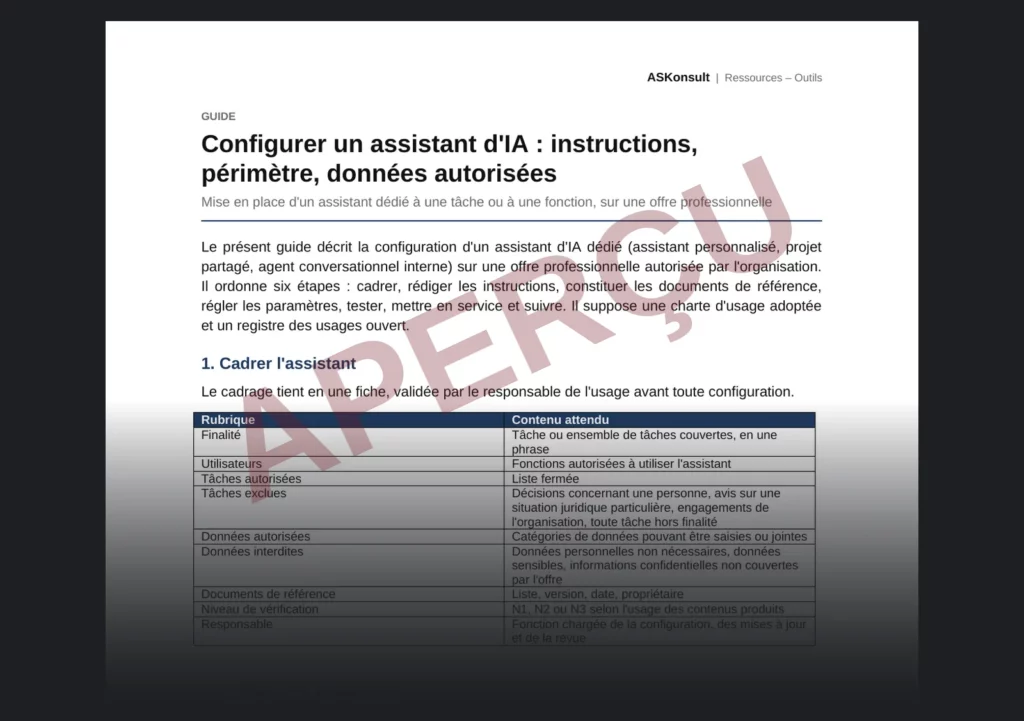
What the guide to configuring an AI assistant contains
- A scoping sheet: purpose, users, authorised and excluded tasks, authorised and prohibited data, verification level.
- An instruction template in seven blocks: role, audience, authorised tasks, excluded tasks, sources, caution, confidentiality and security.
- A checklist for reference documents: selection, removal of unnecessary personal data, dating, replacement of versions.
- Settings: exclusion from model training, restricted sharing, history retention, limited connectors, human validation of external actions.
- A test protocol in five categories, including manipulated instructions and prohibited data.
- Finally, the rules for commissioning and monitoring: entry in the register, anomaly log, review at least once a year.
When to use the guide
The guide is used before configuring an AI assistant: custom assistant, shared project or internal chatbot. It is also used when the assistant is opened to external persons, informed from the outset that it is an AI. Moreover, any change to the instructions, documents or model calls for a new series of tests. It is aimed in particular at the person responsible for the use and at the function in charge of configuration.
Instructions for use
First, the person responsible for the use validates the scoping sheet before any configuration. Next, the instructions are drafted in the infinitive, completing the items in square brackets in the template. Then the reference documents are selected, dated and assigned an owner. The settings are then adjusted, with connectors in read-only mode where possible. Finally, some fifteen questions test the assistant; a non-conformity in categories 3 to 5 suspends commissioning.
Expected outcome
Configuring an AI assistant in line with this guide results in a tool confined to its purpose. It answers on the basis of the reference documents and cites its sources. It states that information is unavailable rather than filling the gap, and refuses out-of-scope requests. The configuration thus remains documented, tested and entered in the register of uses.
Key facts
| Format | PDF, 3 pages; Word |
|---|---|
| Languages | French |
| Version | October 2026 |
| Departments | Information Systems & Digital Transformation |
| Prerequisites | Adopted use charter, open register of uses, authorised professional plan |
| Audience | Use owners and functions in charge of configuration |
Limitations
The guide assumes an adopted use charter and an open register of uses; it does not replace them. In addition, the instruction template must be adapted to each purpose. Moreover, the assistant excludes decisions concerning a person, commitments of the organisation and the assessment of a particular legal situation.
Further reading: Information Systems & Digital Transformation; Regulation (EU) 2024/1689 on artificial intelligence (EUR-Lex).
- Prepared by ASKonsult
- Version: octobre 2026
In the same field
Library · Information Systems & Digital Transformation
Equipping each department with a prompt library by function
The prompt library by function brings together thirty instruction templates for generative artificial intelligence assistants.
Grid · Information Systems & Digital Transformation
Assessing an AI provider and comparing up to three offerings
Choosing an artificial intelligence offering commits the data of the organisation; the grid serves for assessing an AI provider.
Checklist · Information Systems & Digital Transformation
Security of AI uses
The security checklist for AI use orders the controls specific to generative AI tools. These controls are carried out before and during use. They thus cover accounts, data, hidden instructions, extensions and incidents.
Going further Consultation on AI use in business: framing tools and data
General information document; it constitutes neither legal advice nor an opinion on a particular situation. References to legal texts should be checked against the version in force on the date of use.
Licence of use: internal use by the purchaser, non-exclusive and non-transferable; resale, distribution and making available to third parties excluded (Law No. 2-00).
Consulting firm not registered with the Bar; no representation before the courts and no act reserved to the regulated legal professions.