
Model clauses · Information Systems & Digital Transformation
Incorporating AI model clauses into contracts and internal procedures
Governing artificial intelligence in writing requires precise provisions: AI model clauses provide the frameworks for them. They cover contracts in which the organisation is the client or the provider, as well as the data processing agreement. In addition, they supplement the internal regulations and propose information notices intended for the public. Each item in square brackets is to be completed or selected.
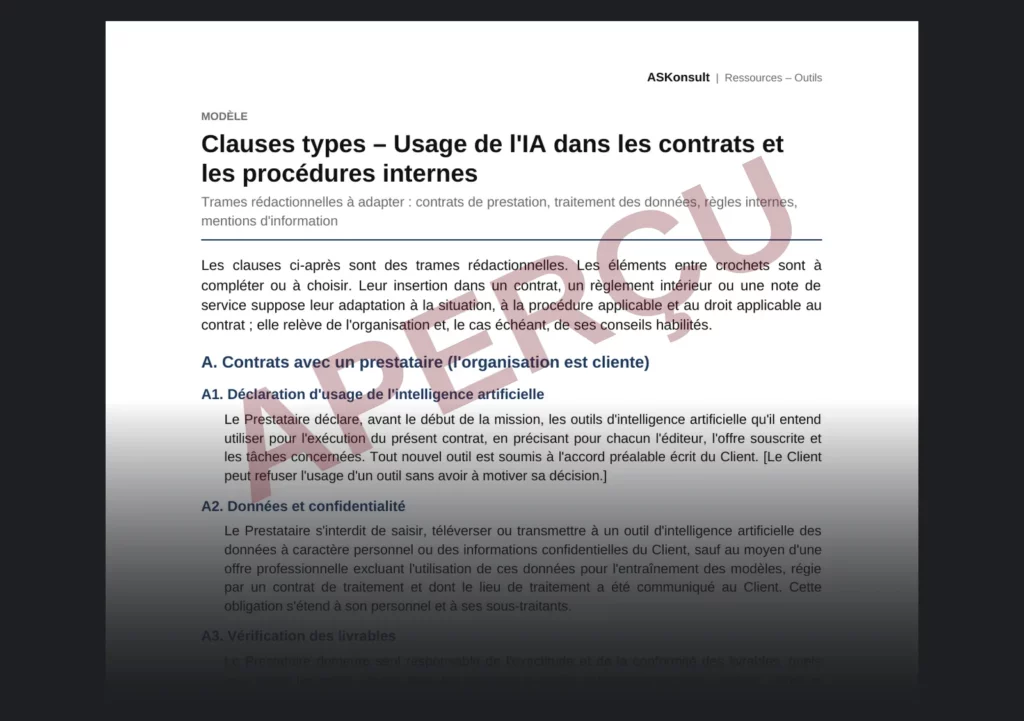
What the collection of AI model clauses contains
- Contracts with a provider: declaration of tools, data and confidentiality, verification of deliverables, rights in deliverables, incidents.
- Contracts in which the organisation is the provider: information to the client and limits, including human review of recommendations before delivery.
- A clause supplementing the processing agreement: no model training, retention of queries, sub-processors, deletion or return.
- Internal procedures: internal regulations clause, individual acknowledgement of having read the charter and appointment of the officer.
- Information notices for a chatbot and for content published with the help of AI.
- Finally, references to Laws No. 09-08, No. 2-00 and No. 65-99 as well as to Regulation (EU) 2024/1689.
When to use the clauses
The clauses are used when drafting a service contract involving AI tools, whether the organisation is the client or the provider. They are also used to supplement a data processing agreement with a processor. Moreover, they accompany the adoption of a use charter: internal regulations, individual acknowledgement and appointment of the officer. They thus concern management, data controllers and AI officers.
Instructions for use
First, the organisation identifies its position: client, provider or controller of processing entrusted to a processor. Next, it selects the relevant clauses and completes the items in square brackets, such as the incident notification deadline. Then it adapts each clause to the procedure and to the law applicable to the contract. Finally, in a company with at least ten regular employees, clause D1 follows the formalities of Article 138 of the Labour Code.
Expected outcome
The organisation has consistent provisions across its contracts, its processing agreement and its internal rules. Obligations relating to data, deliverables and incidents thus receive uniform wording, set out in the AI model clauses.
Key facts
| Format | PDF, 3 pages; Word |
|---|---|
| Languages | French |
| Version | October 2026 |
| Departments | Information Systems & Digital Transformation |
| Prerequisites | Contract or internal regulations to be supplemented; AI use charter |
| Audience | Management, data controllers, AI officers |
Limitations
The clauses remain frameworks: their insertion requires adaptation to the situation, the procedure and the law applicable to the contract. This adaptation is a matter for the organisation and, where appropriate, its authorised advisers. Moreover, references to legal texts must be checked against the wording in force on the date of use. The firm provides no representation before the courts.
Further reading: Information Systems & Digital Transformation; Law No. 09-08 on the protection of individuals with regard to the processing of personal data.
- Prepared by ASKonsult
- Version: octobre 2026
In the same field
Grid · Information Systems & Digital Transformation
Assessing an AI provider and comparing up to three offerings
Choosing an artificial intelligence offering commits the data of the organisation; the grid serves for assessing an AI provider.
Template · Information Systems & Digital Transformation
Adopting and applying a corporate AI charter
To govern artificial intelligence tools, the corporate AI charter sets common rules for all users. It applies to employees, interns, corporate officers and service providers working on the systems.
Checklist · Information Systems & Digital Transformation
Checking the compliance of AI uses
For each use of artificial intelligence, this list sets out the checks on the compliance of AI uses under three frameworks. These are Law No. 09-08, the GDPR and the EU AI Act.
Going further Consultation on AI use in business: framing tools and data
General information document; it constitutes neither legal advice nor an opinion on a particular situation. References to legal texts should be checked against the version in force on the date of use.
Licence of use: internal use by the purchaser, non-exclusive and non-transferable; resale, distribution and making available to third parties excluded (Law No. 2-00).
Consulting firm not registered with the Bar; no representation before the courts and no act reserved to the regulated legal professions.