
Bundle · Information Systems & Digital Transformation
Choosing and combining the three AI use charters
To govern artificial intelligence tools, the bundle brings together three AI use charters: company, association and public body. It is aimed at multi-entity organisations, networks and groupings that combine different legal statuses. The three versions share the same framework; each, however, adds rules specific to its status. Each charter is also available separately.
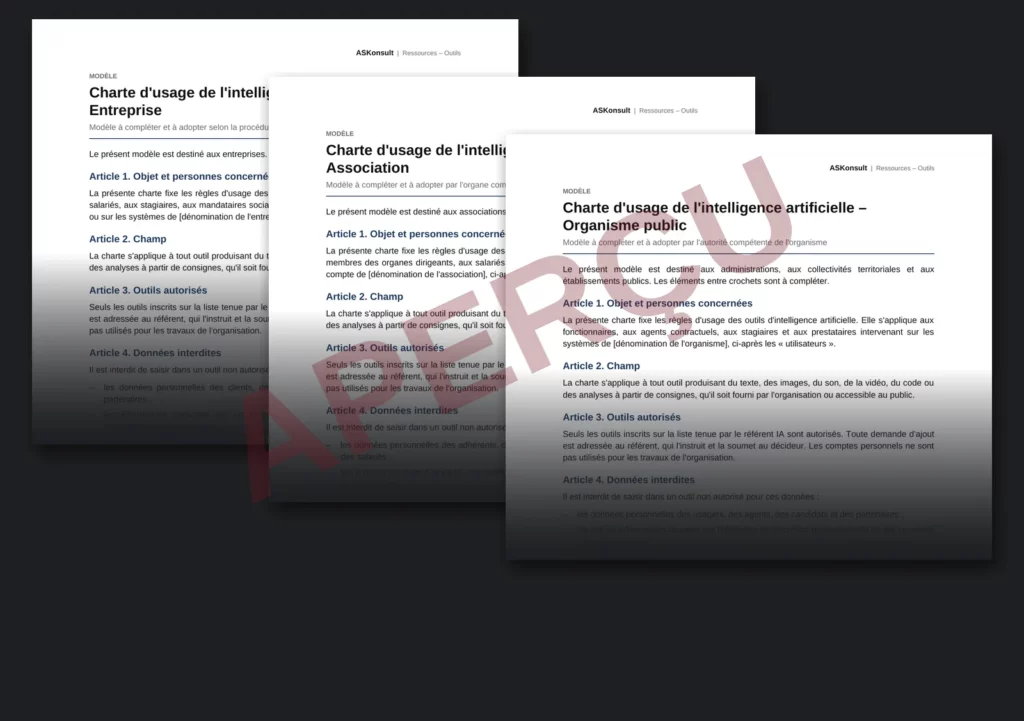
What the bundle of AI use charters contains
- A common framework in thirteen articles: purpose, scope, authorised tools, prohibited data, excluded uses.
- The same levels of human verification, N1 proofreading, N2 checking and N3 validation, as well as transparency and the register of uses.
- In the company charter: client relations, AI clause for service providers and incorporation into the internal regulations.
- In the association charter: beneficiary data, formality with the National Commission for the Control of Personal Data Protection (CNDP) and validation of applications submitted to funders.
- In the public body charter: access to information, cybersecurity, public procurement and professional discretion of staff.
- Finally, references specific to each version, with Law No. 09-08 and Regulation (EU) 2024/1689 common to all three.
When to combine the three versions
The bundle serves multi-entity organisations, networks and groupings that bring together different legal statuses. Each entity then adopts the version suited to its status, while retaining common rules. Verification levels and register headings thus remain comparable from one entity to another. The bundle concerns in particular group management, network heads and AI officers.
Instructions for use
First, each entity identifies its status and selects the corresponding charter. Next, the entities harmonise the common elements: list of authorised tools, verification levels and register headings. Then each charter follows its own adoption procedure: internal regulations, body provided for in the articles of association or competent authority. Finally, the three AI use charters are reviewed at least once a year.
Expected outcome
Each entity has a charter consistent with its status and adopted according to its own procedure. The whole nevertheless shares the same vocabulary, the same verification levels and an identically structured register.
Key facts
| Format | Three charters: PDF, 3 pages each; Word |
|---|---|
| Languages | French |
| Version | October 2026 |
| Departments | Information Systems & Digital Transformation |
| Prerequisites | Status of each entity; appointment of the AI officers and decision-makers |
| Audience | Multi-entity organisations, networks, groupings |
Limitations
The bundle does not merge the three versions into a single text; each charter is adopted separately, according to the procedure specific to each entity. Moreover, references to legal texts must be checked against the wording in force on the date of use. The firm provides no representation before the courts.
Further reading: Information Systems & Digital Transformation; Law No. 09-08 on the protection of individuals with regard to the processing of personal data.
- Prepared by ASKonsult
- Version: octobre 2026
In the same field
Register · Information Systems & Digital Transformation
Keeping the register of AI uses
Uses of artificial intelligence often spread without any inventory; the register of AI uses lists them. It documents, for each use, the information relevant to its governance.
Model clauses · Information Systems & Digital Transformation
Incorporating AI model clauses into contracts and internal procedures
Governing artificial intelligence in writing requires precise provisions: AI model clauses provide the frameworks for them.
Checklist · Information Systems & Digital Transformation
Checking the compliance of AI uses
For each use of artificial intelligence, this list sets out the checks on the compliance of AI uses under three frameworks. These are Law No. 09-08, the GDPR and the EU AI Act.
Going further Consultation on AI use in business: framing tools and data
General information document; it constitutes neither legal advice nor an opinion on a particular situation. References to legal texts should be checked against the version in force on the date of use.
Licence of use: internal use by the purchaser, non-exclusive and non-transferable; resale, distribution and making available to third parties excluded (Law No. 2-00).
Consulting firm not registered with the Bar; no representation before the courts and no act reserved to the regulated legal professions.