
Template · International Business Law
Governing an exchange of information with a mutual non-disclosure agreement
A mutual non-disclosure agreement governs the disclosure of non-public information between two parties contemplating a business relationship. It first defines the protected information and the authorised use. It then sets out the authorised persons, the duration of the obligation and what happens to the information at the end of the exchanges. The template is reciprocal: each party may in turn be the disclosing and the receiving party.
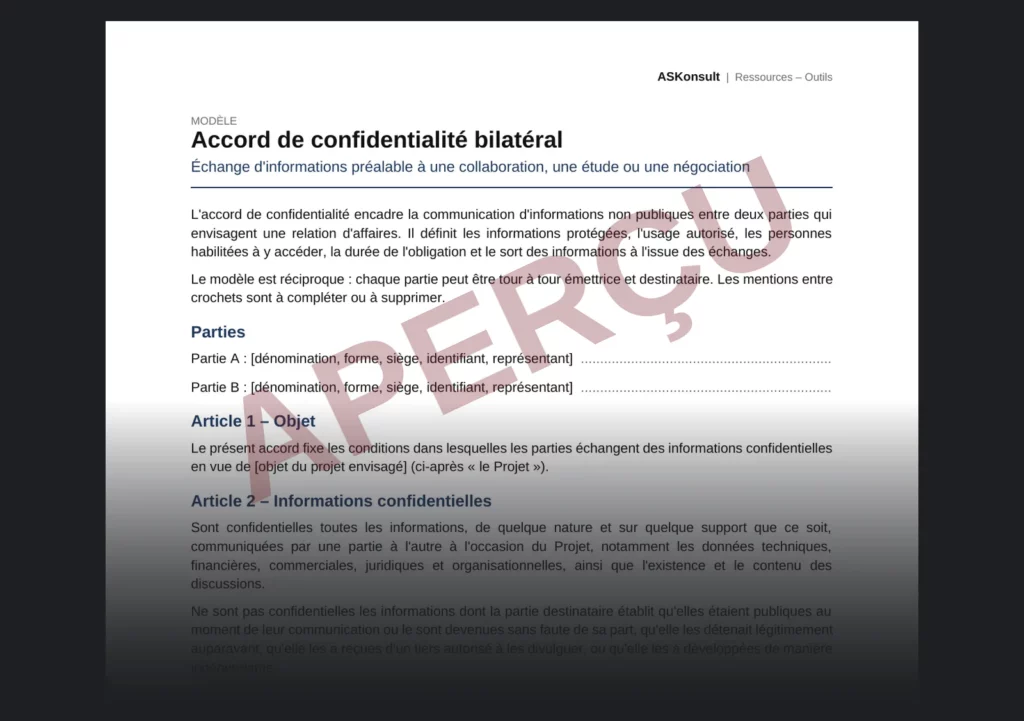
What the mutual non-disclosure agreement template contains
- Identification of the parties and the purpose of the contemplated project.
- The definition of confidential information and its exclusions.
- The obligations of the receiving party, compelled disclosure, then return or destruction.
- No rights granted, duration and compliance with personal data regulations.
- Governing law, the search for an amicable solution and the method of dispute resolution.
- Optional provisions: accuracy, assignment, entire agreement, notices, urgent measures and non-solicitation.
When to enter into the agreement
The template applies from the first exchanges, before a collaboration, a study, a negotiation or an investment. It concerns, in particular, companies in the negotiation phase and project promoters. In addition, a unilateral agreement suffices where only one party discloses information. The references in the document also cover Morocco, the European Union, Spain and France.
Instructions for use
The parties first fill in their identification and the purpose of the project. They then specify the duration of the agreement and that of the confidentiality obligation after its expiry. Next, they choose the governing law, the period for seeking an amicable solution and the court or arbitration. Finally, they keep or delete each optional provision before signing in two originals.
Expected outcome
The mutual non-disclosure agreement thus establishes a written and reciprocal framework before any disclosure. Each party then knows the authorised use, the authorised persons and what happens to the information at the end of the discussions.
Key facts
| Format | PDF, 3 pages; Word |
|---|---|
| Languages | French |
| Version | October 2026 |
| Departments | International Business Law; Governance & Dispute Resolution |
| Prerequisites | Identity of the parties and purpose of the exchanges |
| Audience | Companies in the negotiation phase, project promoters |
Limitations
The template covers neither adaptation to the specific case, nor review, nor validation, nor follow-up, which fall within consultations and packages. It includes no representation. Moreover, a penalty clause can only be considered if the governing law allows it and within its limits.
Further reading: International Business Law; Directive (EU) 2016/943 on the protection of trade secrets (EUR-Lex).
- Prepared by ASKonsult
- Version: octobre 2026
In the same field
Checklist · International Business Law
Key points in an international contract
Key points in international contracts are checked before signature. An international contract indeed overlays several legal systems, languages and currencies. Difficulties then arise from a missing or ambiguous clause.
Checklist · International Business Law
Checking the payment clause of an international contract
The international payment clause allocates risks between seller and buyer. It indeed determines who bears non-payment, exchange rate risk and the cost of the payment term.
Checklist · Financial Engineering & Grants
Negotiating an investment agreement with the State
The investment agreement with the State determines eligibility for the support schemes of the Investment Charter. Framework Law No.
Going further International contract consultation: points of attention and points to negotiate before signing
General information document; it constitutes neither legal advice nor an opinion on a particular situation. References to legal texts should be checked against the version in force on the date of use.
Licence of use: internal use by the purchaser, non-exclusive and non-transferable; resale, distribution and making available to third parties excluded (Law No. 2-00).
Consulting firm not registered with the Bar; no representation before the courts and no act reserved to the regulated legal professions.