
Template · Business Rescue & Turnaround
Requesting ex gratia remission of tax penalties and surcharges
Ex gratia remission of penalties allows the tax administration to grant total or partial remission of surcharges, fines and penalties. The template thus structures the request addressed to the General Directorate of Taxes (DGI). It covers penalties arising from late filing or late payment, without challenging the principal amount. The request is based, in particular, on point 2 of Article 236 of the General Tax Code.
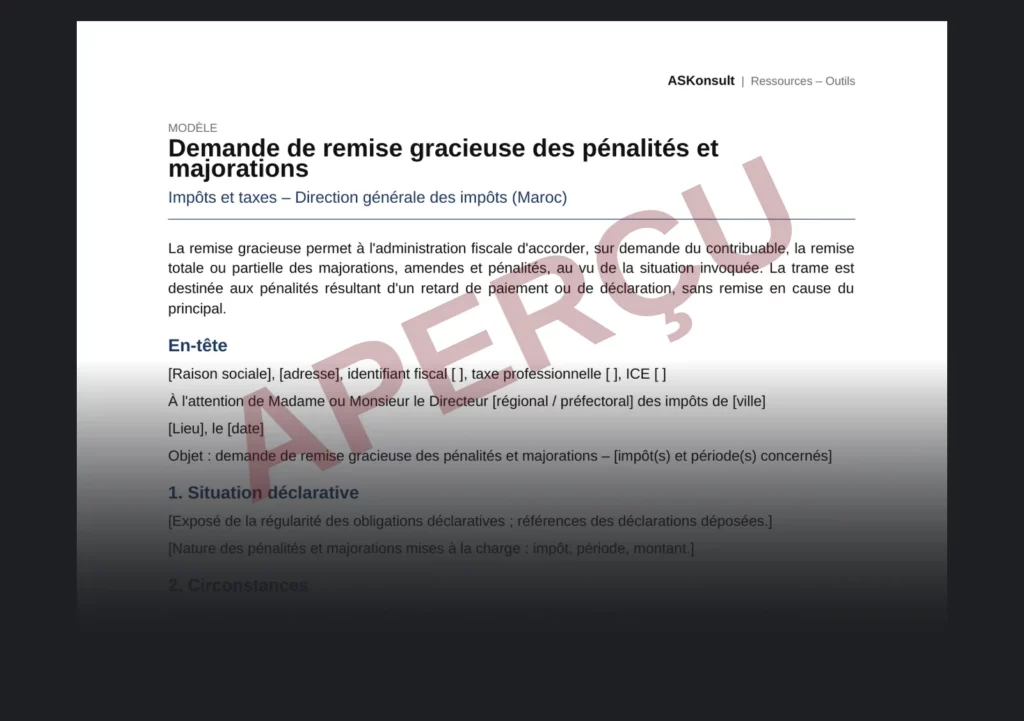
What the ex gratia remission request template contains
- A heading addressed to the regional or prefectural director of taxes, with the company’s identifiers.
- The filing position: returns filed and penalties charged, by tax, period and amount.
- The circumstances that caused the delay, their one-off nature and the absence of any intention to evade tax.
- Regularisation: payment of the principal amount and measures taken to prevent recurrence.
- The request for total or, failing that, partial remission, followed by the list of enclosures.
- Notes on the distinction from a claim, the filing of the request and the follow-up of the decision.
When to request ex gratia remission of penalties
The procedure concerns, in particular, SMEs and mid-sized companies liable for penalties or surcharges. It presupposes that the principal amount is not disputed. Indeed, ex gratia remission challenges neither the principal amount nor the procedure and relates solely to the penalties. By contrast, a challenge to the merits or the amount of the assessment falls under the claim provided for in Article 235. Moreover, the request does not, in itself, suspend collection.
Instructions for use
The company first identifies the taxes, periods and penalties concerned. It then sets out its situation and the circumstances relied upon, with supporting evidence. Next, it pays the principal amount and describes its regularisation measures. Finally, it files the request against acknowledgement of receipt, or through the online services where the procedure is available there. It then keeps the filing date and the acknowledgement of receipt.
Expected outcome
The request for ex gratia remission of penalties thus presents a documented situation and complete supporting documents. The follow-up then reconciles the decision with the amounts placed in collection. A rejection or a partial remission does not, however, prevent settlement of the balance through a payment schedule with the tax collector.
Key facts
| Format | PDF, 2 pages; Word |
|---|---|
| Languages | French |
| Version | October 2026 |
| Departments | Business Rescue & Turnaround |
| Prerequisites | Tax assessment notices, statement of penalties, cash position |
| Audience | SMEs and mid-sized companies liable for penalties or surcharges |
Limitations
The template covers neither representation, nor the drafting of contentious claims, nor adaptation to the specific case. In addition, the addressee of the request is checked against the delegations in force on the filing date.
Further reading: Business Rescue & Turnaround.
- Prepared by ASKonsult
- Version: octobre 2026
In the same field
Checklist · Business Rescue & Turnaround
Identifying the warning signs of business difficulties
The warning signs of business difficulties rarely appear all at once. They first build up as weak signals, whether financial, operational or legal. Yet no dashboard brings them together spontaneously.
Going further Consultation on a business in difficulty in Morocco: reading the warning signs
General information document; it constitutes neither legal advice nor an opinion on a particular situation. References to legal texts should be checked against the version in force on the date of use.
Licence of use: internal use by the purchaser, non-exclusive and non-transferable; resale, distribution and making available to third parties excluded (Law No. 2-00).
Consulting firm not registered with the Bar; no representation before the courts and no act reserved to the regulated legal professions.