
Template · Governance & Dispute Resolution
Establishing a shareholder governance charter
The shareholder governance charter sets out in writing how the shareholders decide, keep informed and resolve a disagreement. The articles of association indeed rarely settle these questions, where most conflicts arise. The charter therefore supplements the articles of association and, where applicable, the shareholders’ agreement. It may not, however, derogate from them: in the event of contradiction, the articles of association and the law prevail.
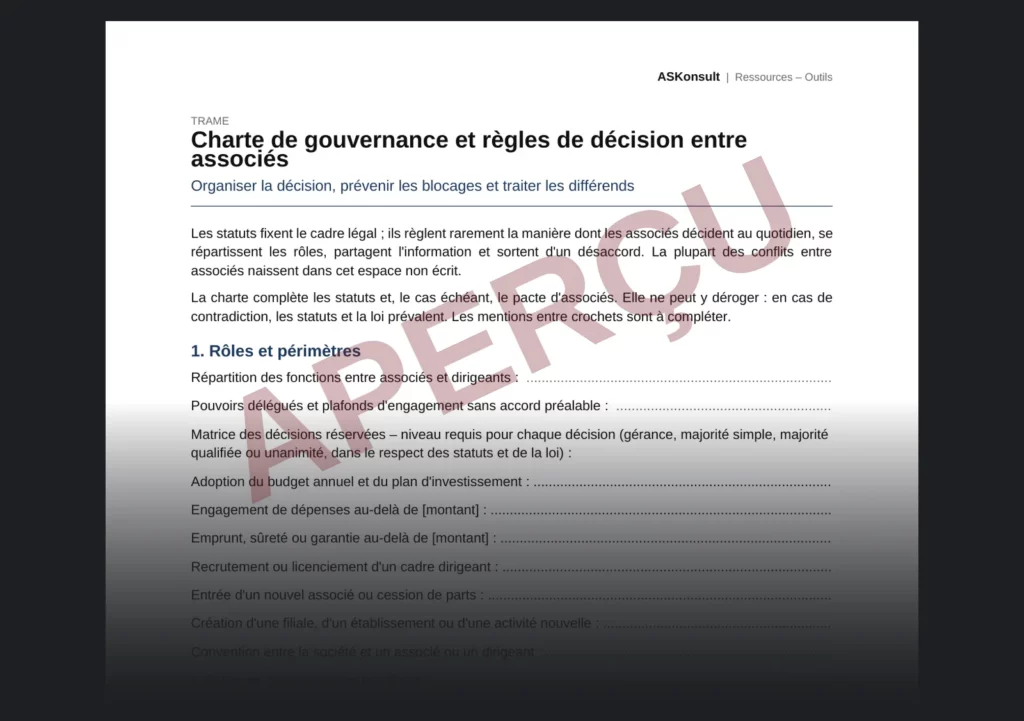
Contents of the shareholder governance charter
- Roles and remits: allocation of functions, delegated powers, commitment ceilings and governing bodies, with frequency, composition and quorum.
- A matrix of reserved decisions: budget, expenditure and borrowing above a threshold, senior executives, transfer of shares, distributions.
- Information and conflicts of interest: shared reporting, equal access to information, declaration of interest, abstention of the interested shareholder.
- Deadlock prevention: disagreement threshold, consultation period, mediation, then a four-step exit procedure.
- Crisis communication: a single spokesperson, a common message to employees, customers and partners, no uncoordinated public statement.
- Finally, four model clauses, a review section and Moroccan, Spanish and French references.
When to draft the charter
The charter is preferably drafted in calm conditions, before any dispute. It then supplements the articles of association on the points they leave open: roles, information, day-to-day decisions. It also serves when disagreements emerge, before they turn into deadlock. Furthermore, a review frequency is set at the time of adoption. It is intended in particular for shareholders of SMEs and for family businesses.
Instructions for use
First, the articles of association and any shareholders’ agreement are reread to identify the rules already set. Next, the matrix assigns each reserved decision its level: management, simple majority, qualified majority or unanimity. The shareholders then complete the items in square brackets: amounts, time limits, criteria, mediator. Finally, the shareholder governance charter is dated, signed and given a review frequency.
Expected outcome
The result is a signed and dated charter. It records the rules on decision-making, information and the prevention of conflicts of interest. It thus organises the exit from deadlock in four steps. During this procedure, day-to-day management remains entrusted to a designated manager, within the limits of the delegated powers.
Key facts
| Format | PDF, 3 pages; Word |
|---|---|
| Languages | French |
| Version | October 2026 |
| Departments | Governance & Dispute Resolution |
| Prerequisites | Articles of association and any shareholders’ agreement |
| Audience | SME shareholders, family businesses |
Limitations
The charter has contractual force only between its signatories; rules enforceable against third parties are a matter for the articles of association. In addition, majorities, quorum and related-party agreements depend on the corporate form and the applicable law. Adaptation to the specific case, review, validation and follow-up fall within consultations and packages. The template includes no representation.
Further reading: Governance & Dispute Resolution; Law No. 95-17 on arbitration and conventional mediation.
- Prepared by ASKonsult
- Version: octobre 2026
In the same field
Questionnaire · International Trade & Export
Preparing for a supplier due diligence audit
The supplier due diligence audit is prepared before the European buyer makes its request. Large European companies indeed have to address adverse impacts on human rights and the environment among their partners.
Matrix · Governance & Dispute Resolution
Stakeholders and crisis messages
The crisis stakeholder matrix prepares crisis communication ahead of time. In a crisis, the organisation indeed lacks the time to identify whom to inform, in what order and through which channel.
Template · International Business Law
Governing an exchange of information with a mutual non-disclosure agreement
A mutual non-disclosure agreement governs the disclosure of non-public information between two parties contemplating a business relationship. It first defines the protected information and the authorised use.
Going further Shareholder governance consultation: preventing decision deadlock
General information document; it constitutes neither legal advice nor an opinion on a particular situation. References to legal texts should be checked against the version in force on the date of use.
Licence of use: internal use by the purchaser, non-exclusive and non-transferable; resale, distribution and making available to third parties excluded (Law No. 2-00).
Consulting firm not registered with the Bar; no representation before the courts and no act reserved to the regulated legal professions.